Norada Real Estate Investments

  • Home
  • Markets
  • Properties
  • Membership
  • Podcast
  • Learn
  • About
  • Contact

Bay Area Housing Forecast: Zillow Predicts 5% Drop in Home Prices

April 24, 2025 by Marco Santarelli

Bay Area Housing Forecast: Zillow Predicts 5% Drop in Home Prices

If you're keeping a close eye on the crazy world of Bay Area real estate, like I am, you've probably felt the ground shifting a bit. Well, the latest word from Zillow is adding to that feeling: their forecast suggests that Bay Area home prices are expected to drop by about 5% by the end of March 2026.

Specifically, for the San Francisco metro area, Zillow is predicting a 5.2% decline between the end of March 2025 and the end of March 2026. This news might bring a mix of emotions, depending on whether you're dreaming of buying a home here or already own one. Let's dive into what this forecast means and what could be driving this shift in one of the nation's most competitive housing markets.

Bay Area Housing Forecast: Zillow Predicts 5% Drop in Home Prices

What's Behind the Predicted Price Dip?

It's not just a random guess, of course. Zillow's prediction is based on a combination of factors they're seeing in the current market and what they anticipate happening over the next year or so. Nationally, they're forecasting a 1.9% decrease in home values for this year, a significant change from their earlier expectation of a slight increase. This nationwide trend is definitely playing a role in what's happening here in our beloved Bay Area.

One of the main reasons for this expected cooling is the interplay between rising available listings and still-high mortgage rates. For a long time, we saw incredibly low inventory in the Bay Area, which drove prices sky-high. Now, more homes are coming onto the market, giving buyers more choices and, importantly, more time to make a decision. This shift in supply and demand dynamics naturally puts some downward pressure on prices.

And let's not forget those mortgage rates. While they've come down from their peak, they're still significantly higher than what we saw just a few years ago. Zillow anticipates rates will likely hover around 6.5% by the end of 2025. These elevated rates make buying a home more expensive, impacting affordability and further influencing the willingness and ability of buyers to pay top dollar.

More Choices for Buyers, More Negotiation for Sellers

From my perspective, as someone who's followed the Bay Area market closely, this forecast feels like a bit of a return to a more balanced market. For years, it's felt like sellers held all the cards. Now, with increased supply, buyers are finally gaining some leverage. They have more homes to consider, and they're not feeling the same intense pressure to make lightning-fast decisions and overpay.

We're already seeing evidence of this shift. Zillow notes that nationally, sellers are cutting prices at record levels to attract bids. This is a clear sign that the frenzy we've experienced is easing, and sellers are having to be more realistic about their asking prices. I wouldn't be surprised to see this trend continue, and even accelerate, in the Bay Area over the coming months.

What About Home Sales?

Interestingly, while Zillow predicts a drop in home values, they also anticipate an increase in existing home sales nationally, projecting around 4.2 million sales in 2025, a 3.3% rise from 2024. This might seem counterintuitive, but it makes sense when you consider the dynamics at play.

As the spring buying season gets underway, Zillow expects a temporary uptick in sales. More importantly, if home prices do indeed soften and mortgage rates potentially decline later in the year, this could significantly improve affordability and bring more buyers back into the market. I think many potential buyers who have been sitting on the sidelines, waiting for a more favorable environment, might finally feel ready to make a move.

The Rental Market: A Different Story?

While the for-sale market is expected to cool somewhat, the rental market presents a slightly different picture. Zillow forecasts that single-family rents will rise by 3.1% in 2025, while multifamily rents are expected to increase by 2.1%. While these growth rates are slower than what we've seen recently, they still indicate an upward trend.

Several factors contribute to this. Firstly, affordability challenges and economic uncertainty are pushing some would-be buyers to delay their home purchases and continue renting. This increased demand, particularly for single-family rentals, is likely to keep upward pressure on rents. Additionally, while apartment construction may be slowing down, the demand for housing in general, especially in a desirable area like the Bay Area, remains strong.

My Take on the Bay Area Forecast

Having observed the ups and downs of the Bay Area real estate market for a while now, I think Zillow's forecast feels pretty grounded. The combination of higher interest rates and increased inventory was bound to have some impact on prices. The rapid appreciation we saw during the pandemic simply wasn't sustainable in the long run.

However, it's crucial to remember that real estate is hyper-local. While Zillow's forecast provides a broad overview for the San Francisco metro area, conditions can vary significantly from city to city and even neighborhood to neighborhood. Some areas might see a more pronounced price correction, while others might remain relatively stable. Factors like local job growth, school district quality, and overall desirability will continue to play a significant role.

For potential buyers who have felt priced out for years, this predicted dip could offer a much-needed opportunity to finally enter the market. It's important to be prepared, do your research, and work with a knowledgeable real estate agent who understands the nuances of the local market.

For current homeowners, a 5% drop might sound concerning. However, it's essential to keep this in perspective. Over the long term, Bay Area real estate has historically appreciated. A moderate correction could actually be a healthy thing for the market, preventing another unsustainable bubble from forming.

What Should You Do?

If you're thinking of buying or selling in the Bay Area, now is the time to be informed and strategic.

  • For Buyers: This could be your chance! Keep a close eye on listings, get pre-approved for a mortgage so you're ready to act when you find the right place, and don't be afraid to negotiate.
  • For Sellers: Be realistic about your pricing expectations. Work with your agent to understand the current market conditions in your specific area and price your home competitively.

In Conclusion

The prediction of a 5% drop in Bay Area home prices by Zillow signals a potential shift in the market dynamics. While it might bring some relief to prospective buyers, current homeowners should focus on the long-term value of their investment. As always, the real estate market is complex and influenced by numerous factors. Staying informed and working with experienced professionals will be key to navigating these evolving conditions.

Work with Norada, Your Trusted Source for

Turnkey Investment Properties

Discover high-quality, ready-to-rent properties designed to deliver consistent returns.

Contact us today to expand your real estate portfolio with confidence.

Contact our investment counselors (No Obligation):

(800) 611-3060

Get Started Now 

Also Read:

  • Bay Area Housing Market: Prices, Trends, Forecast 2025
  • Bay Area Housing Market Predictions 2030
  • Is the San Francisco Housing Market Heating Up in 2025?
  • San Francisco Housing Market Crash 2025: Will it Happen?
  • Bay Area Housing Market Soars With Largest Gain in Home Sales
  • Bay Area Housing Market Forecast for the Next 2 Years: 2025-2026
  • Bay Area Housing Market: What Can You Buy for Half a Million?
  • Bay Area Home Prices Skyrocket: Wealthy Buyers Fuel Market
  • Bay Area Housing Market Booming! Median Prices Hit Record Highs
  • Most Expensive Housing Markets in California
  • SF Bay Area Housing Market Records 19% Sales Growth in July 2024
  • Bay Area Housing Market Heats Up: Home Prices Soar 11.9%

Filed Under: Housing Market, Real Estate Market Tagged With: Bay Area, california, Home Price Forecast, Home Price Trends, Housing Market, Housing Market Forecast, housing market predictions

Trump’s Meme Coin Soars 70% After Exclusive Investor Dinner Announcement

April 24, 2025 by Marco Santarelli

Trump's Meme Coin Soars 70% After Exclusive Investor Dinner Announcement

Trump's Meme Coin has indeed soared. The TRUMP meme coin saw a significant price jump after President Donald Trump announced a private dinner for the top 220 investors. This move highlights the intersection of politics and cryptocurrency, sparking ethical debates and raising questions about the influence of public figures in financial markets.

I have to admit, when I first heard about this, I was a bit taken aback. The idea of the President hosting a dinner for meme coin investors just felt…surreal.

Trump's Meme Coin Soars 70% After Exclusive Investor Dinner Announcement

What Exactly is a Meme Coin?

Let's be real, most people outside the crypto world probably scratch their heads at the term “meme coin.” So, what is a meme coin?

Think of it like this: regular cryptocurrencies, like Bitcoin or Ethereum, are like serious tech companies building important software. They have a clear purpose and try to solve real-world problems. Meme coins, on the other hand, are more like that viral video you shared with your friends – fun, maybe a little silly, and often based on an internet joke or trend.

Unlike Bitcoin and Ethereum, they are often created for entertainment or to capitalize on a viral trend. Its value is driven largely by community support and social media hype rather than intrinsic utility.

Here are a few characteristics:

  • Based on a Meme: They are usually created around an Internet meme or cultural moment.
  • Community-Driven: Their value is largely fueled by online communities and social media buzz.
  • Highly Volatile: Because they rely on hype, their price can swing wildly.
  • Limited Utility: Most meme coins don’t offer any real-world applications or technological innovation.

The $TRUMP Coin: A Primer

The $TRUMP coin, launched in January 2025, falls squarely into this category. Obviously, it's tied to Donald Trump and his political persona.

The $TRUMP coin was launched days before Trump’s inauguration on January 20, 2025.

  • Capitalizing on the excitement surrounding his presidency.
  • Promoted by Trump on his Truth Social and X accounts.
  • Soared by over 300% overnight.
  • Peaked at $74.27 shortly after its debut.

The logo, featuring a cartoon image of Trump raising his fist after surviving an assassination attempt in July 2024, highlights its meme-driven appeal.

The Dinner Invitation: Details and Perks

Now, let's get to the main course (pun intended): the dinner.

On April 23, 2025, it was announced that President Trump would host an “intimate private dinner” for the top 220 $TRUMP coin holders on May 22, 2025, at the Trump National Golf Club in Washington, D.C.

Here's the breakdown:

  • Location: Trump National Golf Club in Washington, D.C.
  • Date: May 22, 2025
  • Attendees: Top 220 $TRUMP coin holders
  • Extra Perks: The top 25 holders get a VIP reception and a White House tour.
  • Organized By: FightFightFight LLC.
  • Important Note: The dinner is explicitly stated not to be soliciting funds.

The Market's Reaction: Up, Up, and Away!

You can probably guess what happened next. The $TRUMP coin‘s value jumped dramatically. Within hours, it surged by over 70%, reaching around $13.99.

Here's a quick recap of the key market stats:

Metric Value
Current Price $13.99 USD
Market Cap $2.77 billion USD
Circulating Supply 200 million TRUMP
24-Hour Trading Volume $3.73 billion USD
All-Time High $74.27 USD

Ethical Red Flags: A Cause for Concern?

Okay, here's where things get a little…complicated. While some might see this as a clever marketing strategy, others (myself included) have some serious concerns.

The biggest issue is the potential conflict of interest. Is it ethical for a public figure, especially one with the power to influence regulations, to be so closely tied to a specific cryptocurrency? The offer of access to the president in exchange for investment can create ethical conflicts with little precedent in presidential history.

It's not just about this dinner or this coin. It's about setting a precedent. What's stopping other politicians from doing the same? Could this lead to a situation where political access is essentially for sale to the highest crypto bidders?

Broader Implications: Politics Meets Crypto

This whole situation highlights the growing intersection of politics and cryptocurrency. The $TRUMP coin example shows how a public figure's endorsement can significantly impact the market.

But it also raises larger questions about regulation:

  • How should meme coins be regulated?
  • What are the ethical boundaries for public officials participating in the crypto space?
  • How do we ensure a fair and transparent crypto market when politicians are involved?

The current lack of clear regulations for meme coins, combined with Trump’s dual role as a crypto promoter and regulator, could complicate efforts to establish a transparent and fair crypto market.

Community Divided: Cheers and Jeers

The crypto community has had mixed reactions. Some see it as genius marketing, while others worry about market integrity.

  • Supporters: Praised it as a bold marketing strategy.
  • Critics: Expressed concerns about conflicts of interest and regulatory oversight.

These reactions underscore the divisive nature of Trump’s involvement in the crypto space, with some seeing it as a genius move to engage investors and others viewing it as a risky precedent.

My Take: A Word of Caution

As much as I find this whole saga fascinating, I also think it's a cautionary tale. Meme coins are inherently risky. Their value is based on hype, not real-world utility. And when you add the potential for ethical conflicts and regulatory uncertainty, it becomes even more important to proceed with extreme caution.

In Conclusion: A Sign of the Times

The $TRUMP coin surge is a sign of the times. It shows how quickly the crypto world is evolving and how political figures are finding new ways to engage with it.

Whether this is a positive or negative development remains to be seen. But one thing is clear: the intersection of politics and cryptocurrency is a space we need to watch closely.

Invest in Turnkey Real Estate With Norada

While meme coins rise and fall with market sentiment, real estate offers tangible, long-term stability and growth.

Don’t chase crypto hype—build wealth with cash-flowing rental properties in prime markets nationwide.

HOT NEW LISTINGS JUST ADDED!

Speak with an investment counselor (No Obligation):

(800) 611-3060

Check Listings

Read More:

  • Stock Market Meltdown: Dow, S&P 500, Nasdaq Hit Hard by Tariff Fears
  • S&P 500 Plunges 6% in Biggest Fall Since 2020 Amid Trade War Fears
  • Stock Market Predictions 2025: Will the Bull Run Continue?
  • S&P 500 Plunges by 2% as Inflation Panic Grips Markets
  • Stock Market Crash: Nasdaq 100 Tanks 3.5% Amid AI Concerns
  • Stock Market Crash Prediction With Huge Discounts on Bitcoin, Gold, Houses
  • S&P 500 Forecast for the Next Year: What to Expect in 2025?
  • Stock Market Predictions for the Next 5 Years
  • Billionaire Warns of Stock Market Crash If Harris Wins Elections
  • Stock Market is Predicted to Surge Regardless of the Election Outcome
  • Echoes of 1987: Is Today’s Stock Market Crash Leading to a Recession?
  • Is the Bull Market Over? What History Says About the Stock Market Crash
  • Wall Street Bear Predicts a Historic Stock Market Crash Like 1929
  • Economist Predicts Stock Market Crash Worse Than 2008 Crisis
  • Stock Market Forecast Next 6 Months
  • Next Stock Market Crash Prediction: Is a Crash Coming Soon?
  • Stock Market Crash: 30% Correction Predicted by Top Forecaster

Filed Under: Economy, Stock Market Tagged With: Stock Market, Stock Market Forecast, Stock Market Predictions

States With the Lowest Mortgage Rates Today – April 23, 2025

April 23, 2025 by Marco Santarelli

States with Lowest Mortgage Rates Today - April 23, 2025

Looking for the states with the cheapest mortgage rates today? As of April 23, 2025, you'll find the most attractive 30-year fixed mortgage rates in New York, Pennsylvania, and California. These states currently boast some of the lowest averages, but it's crucial to remember that rates are always changing, and your individual circumstances will play a big role.

It can be a jungle out there when you’re trying to buy a home. It feels like everyone is speaking a different language filled with confusing terms and numbers. One thing that is clear is that mortgage rates are a HUGE deal. Even a tiny difference in the rate can add up to tens of thousands of dollars over the life of the loan.

So, let’s break down the current mortgage rate situation and see which states are offering the best deals and what impacts the rates.

States With the Lowest Mortgage Rates Today – April 23, 2025

According to recent data from Zillow, these states are showing the most promising 30-year fixed mortgage rates (Investopedia):

  • New York – 6.90%
  • Pennsylvania – 7%
  • California – 7.01%
  • Washington – 7.04%
  • Connecticut – 7.05%
  • Louisiana – 7.05%
  • Michigan – 7.05%
  • New Jersey – 7.05%
  • New Mexico – 7.05%
  • South Carolina – 7.05%

These states registered average rates between 6.90% and 7.05%.

And the Most Expensive States for Mortgages

On the flip side, here are the states where you'll find the highest mortgage rates as of today:

  • West Virginia – 7.15% 
  • Alaska – 7.14%
  • Indiana – 7.12%
  • Maryland – 7.12%
  • Arizona – 7.11%
  • Colorado – 7.11%
  • Hawaii – 7.11%
  • Kentucky – 7.11%
  • Nevada – 7.11%
  • Utah – 7.11%

The average rates in these states range from 7.11% to 7.15%.

Important Note: These are just averages. The actual rate you qualify for will depend on your credit score, down payment, income, and other factors.

Why Do Mortgage Rates Vary by State?

You might be wondering, “Why are mortgage rates different from one state to another?” It’s a great question, and there are several reasons:

  • Different Lenders: Not all lenders operate in every state. This means there is less competition, and they can get away with slightly higher rates.
  • State-Level Regulations: Some states have regulations that impact the cost of doing business for lenders, which can affect rates.
  • Credit Scores and Loan Sizes: The average credit score and loan size can vary from state to state, which can influence the risk profile for lenders.
  • Risk Management: Lenders have different risk management strategies. Some might be more willing to offer lower rates in certain areas based on their assessment of the local market.

National Mortgage Rate Trends

Let's take a step back and look at the bigger picture of mortgage rates across the country:

  • Current National Average (30-year fixed): As of April 23, 2025, the national average for a 30-year fixed-rate mortgage is around 7.07%.
  • Recent Fluctuations: Rates had dropped 20 basis points last week, but then increased 11 basis points over the last four days. This highlights how quickly rates can change.
  • Past Trends: Last month, rates dipped to a low of 6.50%, which was the cheapest average of 2025. Back in September, they even hit a two-year low of 5.89%.

National Averages of Lenders' Best Mortgage Rates

Loan Type New Purchase
30-Year Fixed 7.07%
FHA 30-Year Fixed 7.37%
15-Year Fixed 6.19%
Jumbo 30-Year Fixed 7.12%
5/6 ARM 7.39%

Don't Fall for Teaser Rates!

Be careful when you see those super-low mortgage rates advertised online. These “teaser rates” often come with strings attached, such as:

  • Paying Points: You might have to pay extra upfront fees (points) to get the lower rate.
  • Ultra-High Credit Score: The rate might only be available to borrowers with near-perfect credit.
  • Smaller Loan Amount: The rate might be for a smaller loan than you need.

The rate you actually get will be based on your unique financial situation.

Factors That Determine Your Mortgage Rate

Several things influence the mortgage rate you'll qualify for:

  • Credit Score: A higher credit score generally means a lower interest rate.
  • Down Payment: A larger down payment can reduce the lender's risk and potentially lower your rate.
  • Income: Lenders want to see that you have a stable income and can afford your monthly payments.
  • Debt-to-Income Ratio (DTI): This is the percentage of your monthly income that goes towards debt payments. A lower DTI is generally better.
  • Loan Type: Different loan types (e.g., fixed-rate, adjustable-rate, FHA, VA) come with different interest rates.
  • Property Location: As we've seen, rates can vary by state.

Read More:

When Will the Soaring Mortgage Rates Finally Go Down in 2025?

Mortgage Demand Plunges 13% as Rates Hit 2-Month High in April 2025

Why Are Mortgage Rates Rising Back to 7%: The Key Drivers

Mortgage Rate Forecast 2025: When Will Rates Go Below 6%?

Do Mortgage Rates Go Down During an Economic Recession?

What Makes Mortgage Rates Rise and Fall?

Understanding the forces that drive mortgage rates can help you time your home purchase more effectively. Here are some of the main factors at play:

  • The Bond Market: Mortgage rates often track the yield on the 10-year Treasury bond.
  • The Federal Reserve (The Fed): The Fed's monetary policy, especially its bond-buying programs and the federal funds rate, can influence mortgage rates.
  • Competition: Competition between mortgage lenders can drive rates down.

In the past, the Fed's actions had a huge impact. For example, during the pandemic, the Fed bought billions of dollars in bonds to keep interest rates low. However, when the Fed started to reduce these purchases and raise interest rates to fight inflation, mortgage rates went up significantly.

The Fed's Recent Decisions

The Federal Reserve has been carefully managing interest rates to combat inflation. They aggressively raised the federal funds rate in 2022 and 2023. However, they started making slight rate cuts toward the end of 2024. As of early 2025, the Fed has opted to hold rates steady, and it's uncertain when the next rate cut will occur. This uncertainty adds complexity to the mortgage market.

Shopping Around Is Key

Here's my top advice: Always shop around for the best mortgage rate! Don't just go with the first lender you talk to. Get quotes from multiple lenders and compare their rates, fees, and terms. This can save you a lot of money over the long haul.

Use a Mortgage Calculator

To estimate your potential monthly mortgage payment, use a mortgage calculator. You can enter your home price, down payment, loan term, and interest rate to get a sense of what you might pay each month.

Example:

  • Home Price: $440,000
  • Down Payment: $88,000 (20%)
  • Loan Term: 30 years
  • Interest Rate: 6.67%

Estimated Monthly Payment: $2,649.04

Remember that this is just an estimate. Your actual payment will also include property taxes, homeowners insurance, and potentially private mortgage insurance (PMI) if your down payment is less than 20%.

The Bottom Line

Finding the states with the cheapest mortgage rates is a good starting point, but remember that your individual situation will ultimately determine the rate you qualify for. By understanding the factors that influence mortgage rates and shopping around for the best deal, you can increase your chances of securing a loan that fits your budget and helps you achieve your homeownership dreams.

Work With Norada, Your Trusted Source for

Real Estate Investment in the U.S.

Investing in turnkey real estate can help you secure consistent returns with fluctuating mortgage rates.

Expand your portfolio confidently, even in a shifting interest rate environment.

Speak with our expert investment counselors (No Obligation):

(800) 611-3060

Get Started Now

Also Read:

  • Will Mortgage Rates Go Down in 2025: Morgan Stanley's Forecast
  • Expect High Mortgage Rates Until 2026: Fannie Mae's 2-Year Forecast
  • Mortgage Rate Predictions 2025 from 4 Leading Housing Experts
  • Mortgage Rates Forecast for the Next 3 Years: 2025 to 2027
  • 30-Year Mortgage Rate Forecast for the Next 5 Years
  • 15-Year Mortgage Rate Forecast for the Next 5 Years
  • Why Are Mortgage Rates Going Up in 2025: Will Rates Drop?
  • Why Are Mortgage Rates So High and Predictions for 2025
  • Will Mortgage Rates Ever Be 3% Again in the Future?
  • Mortgage Rates Predictions for Next 2 Years
  • Mortgage Rate Predictions for Next 5 Years
  • Mortgage Rate Predictions: Why 2% and 3% Rates are Out of Reach
  • How Lower Mortgage Rates Can Save You Thousands?
  • How to Get a Low Mortgage Interest Rate?
  • Will Mortgage Rates Ever Be 4% Again?

Filed Under: Financing, Mortgage Tagged With: Interest Rate, mortgage, Mortgage Rate Trends, mortgage rates, Mortgage Rates Predictions, Mortgage Rates Today

New Home Sales Boom Defying Expectations in a Bumpy Economy

April 23, 2025 by Marco Santarelli

New Home Sales Boom Defying Expectations in a Bumpy Economy

Despite some economic uncertainty, new home sales are actually exceeding expectations! In March 2025, we saw a surprising increase in the purchase of newly built homes, showing resilience in the face of wavering consumer confidence. Let's dive into the details and understand why this is happening, and what it means for you, whether you're a buyer, seller, or just curious about the new construction home market.

New Home Sales Boom Defying Expectations in a Bumpy Economy

A Surprising Surge in Sales

The numbers don't lie. In March 2025, new single-family home sales reached a seasonally adjusted annual rate (SAAR) of 724,000 nationwide. This is a significant 7.4% jump from February's revised rate of 674,000. What's even more interesting is that sales of newly built homes are 6.0% higher than they were in March 2024. These numbers were reported by the U.S. Census Bureau, so they are accurate and reliable.

It is surprising because it bucks the trend of current economy. The consumer sentiment is definitely not the highest and there is a definite ‘wait and watch' approach.

Digging Deeper: Price Cuts and Mortgage Rates

So, what's driving this unexpected increase? Well, it seems like a combination of factors is at play, with price cuts and lower mortgage rates leading the charge. Here's a breakdown:

  • Price Adjustments: More builders are strategically cutting prices to attract buyers. Zillow data indicates that, at the national level, the price per square foot of new construction homes is no longer on the rise.
  • Mortgage Rate Relief: While still not at historic lows, mortgage rates are comparatively lower than they were last year. This is helping to keep the market active, giving potential buyers a bit more breathing room in their budgets.
  • Regional Variations: The South experienced a remarkable 13.6% increase in new home sales in March. This is likely due to higher housing inventory in the region, leading to more significant price reductions.

I think one of the biggest things that's driving this is consumer confidence. People are tired of waiting. They want to get into a new home, they are also banking on the rates reducing in the future. The demand is so great that, prices in some markets will start to rise later in the year.

The Numbers Behind the Story

To get a clearer picture, let's look at some key figures:

  • Median Price: The median price of new houses sold in March was $403,600, which is a 7.5% decrease compared to the previous year. This is good news for buyers!
  • Housing Inventory: The seasonally adjusted estimate of new houses for sale at the end of March was 503,000, representing an 8.3-month supply at the current sales rate. This is a slight decrease from 8.9 months in February and only marginally higher than the 8.2 months in March 2024, but inventories are still healthy.

Price Cuts: Strategic, Not Desperate

It's important to note that while builders are cutting prices, these aren't desperate measures. According to the National Association of Home Builders (NAHB):

  • More Builders Cutting Prices: In March, 29% of builders cut prices, compared to 24% in March 2024.
  • Average Price Reduction: However, the average price reduction in March remained at just 5%, lower than the 6% seen in March 2024.
  • Sales Incentives: The share of builders offering sales incentives has remained roughly unchanged. Approximately 59% of builders provided sales incentives of all forms in March, compared to 60% a year ago.

These numbers suggest that builders are making calculated adjustments to attract buyers without sacrificing their profit margins completely.

Why This Matters

So, why is this all important? Because the housing market is a key indicator of the overall economy. Here's what the new home sales data tells us:

  • Resilience in the Face of Uncertainty: Despite economic jitters, a cooling labor market, and waning consumer confidence, the spring housing market is proving to be more active than last year.
  • Negotiating Power for Buyers: With inventory levels rising, buyers have more negotiating leverage. Builders are more willing to offer price cuts and incentives to close deals.
  • Strategic Price Adjustments: Builders are responding to market conditions by making strategic price cuts, which are helping to support sales.

Looking Ahead: A Positive Outlook?

Given the current trends, what can we expect for the rest of 2025?

  • Stable Demand: Housing demand is surprisingly stable despite the economic challenges.
  • Potential for Growth: Unless mortgage rates spike again, it's likely that 2025 will see more new home sales than the previous year.

As someone who has been following the housing market for a while, I am cautiously optimistic. The factors are lining up in a way that new homes are still an attractive option for buyers.

The Importance of Regional Differences

While the national trends offer a broad overview, it's crucial to remember that the housing market is highly localized. What's happening in the South might not be the same as what's happening in the Northeast or the West Coast. Here's why regional differences matter:

  • Inventory Levels: Some regions have higher inventory levels than others, leading to more competitive pricing.
  • Economic Conditions: Local economies can vary significantly, impacting job growth and consumer confidence.
  • Demographic Trends: Population growth and migration patterns can influence housing demand in specific areas.

When looking at the new home sales data, it's always a good idea to consider the regional context. Talk to local real estate experts to get a better understanding of what's happening in your specific area.

What Does This Mean for Buyers?

If you're in the market for a new home, the current conditions offer some advantages:

  • More Choices: With rising inventory levels, you have more options to choose from.
  • Negotiating Power: Don't be afraid to negotiate with builders on price and incentives.
  • Lower Prices: The median price of new houses sold is down compared to last year, making them more affordable.

Of course, it's still important to do your homework. Get pre-approved for a mortgage, work with a qualified real estate agent, and carefully consider your budget.

What Does This Mean for Sellers (Builders)?

For builders, the current market requires a strategic approach:

  • Price Competitively: Be willing to adjust prices to attract buyers.
  • Offer Incentives: Consider offering incentives such as upgrades, closing cost assistance, or rate buydowns.
  • Focus on Quality: Emphasize the quality and features of your homes to stand out from the competition.

In Conclusion

The new home sales market is defying expectations in 2025, with sales exceeding projections despite economic uncertainty. Lower mortgage rates and more widespread price cuts are supporting this growth, giving buyers more negotiating power. While the market is still navigating some bumpy conditions, the overall outlook is cautiously optimistic. As the year progresses, I'll be keeping a close eye on these trends and providing updates.

Related Articles:

  • New Home Sales: Trends and Forecast for 2025
  • New-Home Sales Rise as Mortgage Rates Drop Significantly
  • Historical Home Sales Data in the United States
  • Housing Market: New Home Sales Fall in August, But Remain Strong
  • New Home Sales Fell in April: Will they Rebound? Predictions
  • Pending Home Sales Trends and Predictions

Filed Under: Housing Market Tagged With: home sales, New Home Sales, New Housing Sales

Is the San Francisco Housing Market Heating Up in 2025?

April 23, 2025 by Marco Santarelli

Is the San Francisco Housing Market Heating Up in 2025?

If you're eyeing a piece of the San Francisco real estate pie, or maybe thinking of selling your own, here's the headline: San Francisco home prices did indeed rise in March 2025, with a median listing price hitting $1,197,500. While this increase is typical for this time of year, it's essential to understand the nuances behind the numbers to make informed decisions. So, let's dive into the details.

San Francisco Home Prices Rise in March 2025: What This Means for You

Is the San Francisco Housing Market Heating Up?

As someone who has been following the San Francisco housing market for quite a while, I can tell you it's always a fascinating story. The city's unique blend of tech wealth, limited space, and desirable location creates a real estate market unlike any other. And the increase in March doesn't mean that it's time to rush to buy any house that hits the market. It means it is time to start paying closer attention.

Understanding the March 2025 Data

Let's break down the numbers from Realtor.com:

  • Median Listing Price: $1,197,500 (a substantial increase from the previous month)
  • Inventory: 922 homes for sale (a 20.4% increase from the previous month and 1.1% increase year over year)
  • New Listings: 648 (a 29.1% increase from the previous month and 14.1% increase year over year)
  • Time on Market: 52 days (7 days less than the previous month, but 16 days more than the same month last year)
  • Price per Square Foot: Increased 0.4% compared to the previous month.

Inventory Increase: A Double-Edged Sword

The fact that the number of homes for sale has increased is important. More options for buyers can cool down the market. On the other hand, more listings might tempt sellers to test the waters, thinking they can get a premium price.

What's really interesting is the comparison to last year. Inventory is slightly up (1.1%) compared to March 2024, but homes are taking significantly longer to sell (16 days more). This suggests a slight cooling despite the increase in median listing price.

San Francisco vs. the Nation: A Tale of Two Markets

It's always crucial to put San Francisco's real estate trends into perspective. Here's how the city compares to the national market:

  • Price per Square Foot: San Francisco's increase (0.4%) lagged behind the national increase (1.6%). This means, despite the overall price increase, San Francisco is not appreciating as quickly as the rest of the country right now.
  • Inventory: San Francisco's inventory increase (20.4%) was significantly higher than the national increase (5.3%). This suggests more competition among sellers in San Francisco.
  • New Listings: San Francisco's increase in new listings (29.1%) was also higher than the national increase (23.3%).

Why is San Francisco Lagging Behind?

Several factors could be contributing to San Francisco's slower growth compared to the national average:

  • High Cost of Living: San Francisco's already sky-high cost of living might be pushing some potential buyers to other areas.
  • Remote Work: The rise of remote work has allowed many to leave the city without changing jobs. The pandemic and the rise of more flexible company working arrangements have made this an important part of understanding price fluctuations.
  • Tech Industry Fluctuations: Any volatility in the tech industry, a major employer in San Francisco, can impact the housing market.
  • Higher Interest Rates: The increase in mortage rates may have impacted the market and made it tougher for buyers to afford property.

What Does This Mean for Buyers?

If you're looking to buy in San Francisco, here's what I think you should consider:

  • Don't Panic Buy: Despite the price increase, the market isn't necessarily overheating. Take your time to find the right property.
  • Negotiate: With more inventory and homes taking longer to sell, you may have more negotiating power than you think. Don't be afraid to make a reasonable offer.
  • Consider Location: Prices can vary significantly depending on the neighborhood. Do your research to find an area that fits your budget and lifestyle.
  • Get Pre-Approved: Being pre-approved for a mortgage will give you a competitive edge and help you move quickly when you find the right property.

What Does This Mean for Sellers?

If you're thinking of selling, here's my advice:

  • Don't Overprice: While prices have risen, don't get greedy. Overpricing your home could lead to it sitting on the market for longer than you want.
  • Stage Your Home: With more competition, it's essential to make your home stand out. Staging can help potential buyers envision themselves living in the space.
  • Be Patient: Homes are taking longer to sell than they were last year. Be prepared to wait a bit longer to find the right buyer.
  • Consider Timing: Spring is generally a good time to sell, but keep an eye on market trends. If you're not in a rush, you might want to wait for a more favorable time.

The Bigger Picture: Long-Term Investment

Despite the current fluctuations, San Francisco real estate has historically been a solid long-term investment. The city's unique characteristics and limited supply of housing mean that prices are likely to continue to rise over time.

However, it's essential to remember that real estate is a cyclical market. Prices can go up and down, and there's no guarantee of future appreciation. That's why it's crucial to do your research, understand your financial situation, and make informed decisions.

My Final Thoughts

The San Francisco housing market is always evolving. It requires a keen understanding of market data, and a good degree of patience. While the March 2025 data shows a price increase, it also reveals a more nuanced picture with increased inventory and slower sales.

Whether you're a buyer or a seller, staying informed and working with a trusted real estate professional is key to navigating this complex market.

Work with Norada, Your Trusted Source for

Turnkey Investment Properties

Discover high-quality, ready-to-rent properties designed to deliver consistent returns.

Contact us today to expand your real estate portfolio with confidence.

Contact our investment counselors (No Obligation):

(800) 611-3060

Get Started Now 

Also Read:

  • Bay Area Housing Market: Prices, Trends, Forecast 2025
  • Bay Area Housing Market Predictions 2030
  • San Francisco Housing Market Crash 2025: Will it Happen?
  • Bay Area Housing Market Soars With Largest Gain in Home Sales
  • Bay Area Housing Market Forecast for the Next 2 Years: 2025-2026
  • Bay Area Housing Market: What Can You Buy for Half a Million?
  • Bay Area Home Prices Skyrocket: Wealthy Buyers Fuel Market
  • Bay Area Housing Market Booming! Median Prices Hit Record Highs
  • Most Expensive Housing Markets in California
  • SF Bay Area Housing Market Records 19% Sales Growth in July 2024
  • Bay Area Housing Market Heats Up: Home Prices Soar 11.9%
Filed Under: Housing Market, Real Estate Market Tagged With: Bay Area, california, Home Price Forecast, Home Price Trends, Housing Market, Housing Market Forecast, housing market predictions

Mortgage Demand Plunges 13% as Rates Hit 2-Month High in April 2025

April 23, 2025 by Marco Santarelli

Mortgage Demand Plunges 13% as Rates Hit 2-Month High in April 2025

If you're thinking about buying a home, you've probably noticed some unsettling news lately. Weekly mortgage demand plunges are making headlines, and for good reason. Last week alone, total mortgage application volume dropped a significant 12.7%. This sharp decline is a clear sign that something's shifting in the housing market, and it's worth understanding what's driving this change.

Mortgage Demand Plunges 13% as Rates Hit 2-Month High in April 2025

Why the Sudden Drop?

Several factors are contributing to this dip in mortgage demand. Here’s a breakdown:

  • Rising Interest Rates: The most immediate cause is the uptick in interest rates. The average contract interest rate for a 30-year fixed-rate mortgage jumped to 6.90%, the highest it's been in two months. These increases can significantly impact a homebuyer's budget, making it harder to qualify for a loan or afford the monthly payments.
  • Economic Uncertainty: People are nervous about the overall economy. Worries about a potential slowdown, job security, and the recent volatility in the stock market are making potential buyers hesitant.
  • Stock Market Volatility: Speaking of the stock market, the recent downturn has made some potential buyers unwilling to sell their stocks to make a down payment on a house.
  • High Home Prices: Even with the drop in demand, home prices are still relatively high in many areas, making affordability a major hurdle for first-time buyers, in particular.

Breaking Down the Numbers: A Closer Look

To really grasp the situation, let's dig deeper into the numbers:

  • Refinance Applications Plunge: Refinance applications took a big hit, dropping 20% in just one week. While they're still higher than a year ago (by about 43%), the rate at which they're falling suggests a cooling trend. The refinance share of overall mortgage activity decreased to 37.3% from 41.3% the prior week.
  • Purchase Applications Also Decline: Applications for mortgages to purchase a home decreased 7%. This suggests potential homebuyers are pulling back on buying decisions in general.
  • Rate Volatility: Mortgage rates moved higher and then appeared to plateau briefly, but that doesn't necessarily mean they'll stay there. As one expert noted, headlines can rattle the market, sending rates higher.

What Does This Mean for You?

Whether you're a buyer, seller, or homeowner, these changes in the mortgage market have implications:

  • For Buyers: If you're a buyer, higher interest rates mean you'll pay more over the life of your loan. It's essential to carefully consider your budget and shop around for the best rates. Weigh your options and consider if waiting makes sense, even if it means potentially missing out on your dream home now.
  • For Sellers: Sellers might need to adjust their expectations. With demand softening, homes might take longer to sell, and you might not get as many offers as you would have a few months ago. It’s smart to work with your real estate agent to price your home competitively and make it as appealing as possible to potential buyers.
  • For Homeowners: If you're a homeowner, now might not be the best time to refinance unless you can secure a significantly lower rate. Keep an eye on interest rate trends and consider your long-term financial goals.

The Expert Take: What the Professionals Are Saying

Joel Kan, vice president and deputy chief economist at the MBA, highlights the role of economic uncertainty and rate volatility in impacting prospective homebuyers. This underscores the importance of keeping a close watch on economic indicators and news that could influence interest rates.

Matthew Graham, chief operating officer at Mortgage News Daily, points out how news headlines can impact the market. This emphasizes the sensitivity of the mortgage market to broader economic and political events.

My Own Perspective

Having watched the housing market for years, I've learned that it's rarely predictable. What we're seeing now is a complex interplay of factors, including interest rates, economic jitters, and investor sentiment. I believe that we're entering a period of greater caution in the housing market, where buyers and sellers will need to be more strategic and informed.

The Importance of Careful Planning

If you are looking to buy a home, it is vital that you work with a great lender and financial advisor and carefully consider the pros and cons. If you are selling a home, think carefully about the timing and what you are realistically going to get for it.

Historical Context and Potential Future Scenarios

It's crucial to remember that mortgage rates, while higher than they were a year or two ago, are still within a reasonable historical range. Looking back over the past few decades, we've seen rates much higher than 6.90%. This perspective can help calm nerves and avoid panic decisions.

As for the future, several scenarios are possible:

  • Scenario 1: Rates Stabilize: If the economy stabilizes and inflation cools, mortgage rates could level off, leading to a gradual recovery in demand.
  • Scenario 2: Rates Continue to Rise: If inflation persists and the Federal Reserve continues to raise interest rates, mortgage demand could fall further, potentially leading to a slowdown in the housing market.
  • Scenario 3: Economic Recession: A full-blown recession could significantly impact the housing market, leading to lower prices and reduced demand.

Read More:

Why Are Mortgage Rates Rising Back to 7%: The Key Drivers

Mortgage Rate Forecast 2025: When Will Rates Go Below 6%?

Do Mortgage Rates Go Down During an Economic Recession?

Practical Advice for Navigating the Current Market

Here's some practical advice for navigating the current mortgage market:

  • Shop Around for the Best Rates: Don't settle for the first rate you're offered. Get quotes from multiple lenders to ensure you're getting the best possible deal.
    • Compare interest rates and fees charged by lenders.
    • Check for any discounts or special programs you may qualify for.
  • Improve Your Credit Score: A higher credit score can help you qualify for a lower interest rate.
    • Pay your bills on time.
    • Reduce your credit card balances.
    • Avoid opening new credit accounts.
  • Save for a Larger Down Payment: A larger down payment can lower your monthly payments and potentially help you avoid private mortgage insurance (PMI).
  • Consider an Adjustable-Rate Mortgage (ARM): While ARMs come with some risk, they may offer lower initial interest rates than fixed-rate mortgages.
  • Work with a Reputable Real Estate Agent: A good agent can help you navigate the market, negotiate effectively, and find the right property for your needs.
  • Be Patient and Persistent: Finding the right home and securing a mortgage can take time. Be patient and don't give up easily.

The Bottom Line

The recent plunge in weekly mortgage demand is a reminder that the housing market is constantly evolving. By staying informed, understanding the factors at play, and working with qualified professionals, you can make sound financial decisions and achieve your homeownership goals. I am cautiously optimistic that the market will soon find it's footing.

Work With Norada, Your Trusted Source for

Real Estate Investment in the U.S.

Investing in turnkey real estate can help you secure consistent returns with fluctuating mortgage rates.

Expand your portfolio confidently, even in a shifting interest rate environment.

Speak with our expert investment counselors (No Obligation):

(800) 611-3060

Get Started Now

Also Read:

  • Will Mortgage Rates Go Down in 2025: Morgan Stanley's Forecast
  • Expect High Mortgage Rates Until 2026: Fannie Mae's 2-Year Forecast
  • Mortgage Rate Predictions 2025 from 4 Leading Housing Experts
  • Mortgage Rates Forecast for the Next 3 Years: 2025 to 2027
  • 30-Year Mortgage Rate Forecast for the Next 5 Years
  • 15-Year Mortgage Rate Forecast for the Next 5 Years
  • Why Are Mortgage Rates Going Up in 2025: Will Rates Drop?
  • Why Are Mortgage Rates So High and Predictions for 2025
  • Will Mortgage Rates Ever Be 3% Again in the Future?
  • Mortgage Rates Predictions for Next 2 Years
  • Mortgage Rate Predictions for Next 5 Years
  • Mortgage Rate Predictions: Why 2% and 3% Rates are Out of Reach
  • How Lower Mortgage Rates Can Save You Thousands?
  • How to Get a Low Mortgage Interest Rate?
  • Will Mortgage Rates Ever Be 4% Again?

Filed Under: Financing, Mortgage Tagged With: Interest Rate, mortgage, Mortgage Rate Trends, mortgage rates, Mortgage Rates Predictions, Mortgage Rates Today

Today’s Mortgage Rates – April 23, 2025: Treasury Yield Hike Pushes Rates Higher

April 23, 2025 by Marco Santarelli

Today's Mortgage Rates - April 23, 2025: Treasury Yield Hike Pushes Rates Higher

As of today, April 23, 2025, the average 30-year fixed mortgage rate is 6.87%, according to Zillow. While this is a snapshot in time, understanding the factors influencing these rates is key to making informed financial decisions. Let’s dive into what’s happening in the mortgage world today and what it might mean for you.

Today's Mortgage Rates – April 23, 2025: Treasury Yield Hike Pushes Rates Higher

Why Are Mortgage Rates on the Move?

Mortgage rates don't just pop out of thin air. They're closely tied to the 10-year Treasury yield. Think of this yield as a benchmark for how confident investors are in the U.S. economy. When investors are optimistic, they often sell off Treasuries to invest in riskier assets, pushing the yield higher. And as the Treasury yield rises, so do mortgage rates.

This past week, we've seen a slight increase in the 10-year Treasury yield, and as a result, mortgage rates are following suit. It’s like a little dance they do together.

The Elephant in the Room: Politics and the Fed

Okay, let's talk about something a little more controversial: politics. Recent reports indicate that President Trump’s criticism of the Federal Reserve Chair, Jerome Powell, is causing some ripples in the market. Apparently, he called Powell “Mr. Too Late” and “a major loser” in a social media post.

Now, normally, this wouldn't directly affect mortgage rates, but here’s the thing: when investors lose confidence in the Fed's independence – meaning they worry political pressure might sway the Fed's decisions – they tend to sell off those seemingly safe Treasury bonds. This sell-off drives yields, and therefore mortgage rates, higher.

It’s like a game of dominoes: Political uncertainty knocks over investor confidence, which in turn pushes up Treasury yields and ultimately, mortgage rates.

What This Means for You: Should You Buy Now?

The million-dollar question! With rates hovering where they are, many potential buyers are understandably hesitant. Should you wait for rates to drop? The truth is, nobody has a crystal ball. Rates aren't expected to suddenly plummet anytime soon. So, if you're financially ready to buy a home and have found the right property, don't let slightly elevated rates paralyze you.

  • Here's my take: Waiting for the “perfect” rate can be a gamble. If rates continue to rise, you'll end up paying more for your mortgage in the long run. On the other hand, waiting could mean missing out on your dream home. Ultimately, the decision depends on your individual circumstances and risk tolerance.

Today's Mortgage Rates: A Closer Look

Here’s a breakdown of the current national average mortgage rates, according to Zillow:

  • 30-year fixed: 6.87%
  • 20-year fixed: 6.73%
  • 15-year fixed: 6.18%
  • 5/1 ARM: 7.12%
  • 7/1 ARM: 7.41%
  • 30-year VA: 6.44%
  • 15-year VA: 5.87%
  • 5/1 VA: 6.33%

Refinancing? Here's What You Need to Know

Thinking about refinancing your current mortgage? Here are the latest refinance rates:

  • 30-year fixed: 6.92%
  • 20-year fixed: 6.71%
  • 15-year fixed: 6.27%
  • 5/1 ARM: 7.31%
  • 7/1 ARM: 7.26%
  • 30-year VA: 6.52%
  • 15-year VA: 6.16%
  • 5/1 VA: 6.43%

Keep in mind that refinance rates are often slightly higher than purchase rates, although this isn’t always the case.

Understanding Your Mortgage Options: A Quick Guide

Let's break down some of the most common mortgage types:

1. 30-Year Fixed Mortgage: The Classic Choice

  • Pros: Lower monthly payments, predictable payments (your interest rate stays the same for the life of the loan).
  • Cons: Higher interest rate compared to shorter-term loans, you'll pay more interest over the life of the loan.
  • Who it's good for: Homebuyers who prioritize affordability and predictability.

2. 15-Year Fixed Mortgage: The Faster Track to Ownership

  • Pros: Lower interest rate, you'll pay off your mortgage in half the time, saving you a significant amount of money on interest.
  • Cons: Higher monthly payments.
  • Who it's good for: Homebuyers who can afford higher monthly payments and want to build equity faster.

3. Adjustable-Rate Mortgage (ARM): The Gamble

  • Pros: Typically has a lower introductory interest rate than fixed-rate mortgages for a set period (e.g., 5 years).
  • Cons: After the introductory period, the interest rate can adjust up or down, making your monthly payments unpredictable.
  • Who it's good for: Homebuyers who plan to move before the introductory period ends or who are comfortable with the risk of fluctuating interest rates. But be cautious, given current rates, fixed-rate options might be more appealing!

Read More:

Mortgage Rates Trends as of April 22, 2025

Why Are Mortgage Rates Rising Back to 7%: The Key Drivers

Mortgage Rate Forecast 2025: When Will Rates Go Below 6%?

Do Mortgage Rates Go Down During an Economic Recession?

Key Considerations When Choosing a Mortgage

  • Your Financial Situation: Assess your income, debts, and credit score. A higher credit score typically qualifies you for a lower interest rate.
  • Your Down Payment: A larger down payment can lower your monthly payments and reduce the amount of interest you pay over the life of the loan.
  • Your Risk Tolerance: Are you comfortable with the potential for fluctuating interest rates? If not, a fixed-rate mortgage might be a better choice.
  • Your Long-Term Plans: How long do you plan to stay in the home? If you plan to move within a few years, an ARM might be a viable option.

Looking Ahead: Where Are Mortgage Rates Headed?

Predicting the future of mortgage rates is like trying to predict the weather – it's never an exact science. There's a lot of uncertainty surrounding the economy and global events, making it difficult to pinpoint exactly where rates will land.

While it's unlikely we'll see rates drop back down to the historic lows of 2020 and 2021 (when 30-year fixed rates fell below 3%), many experts anticipate a gradual easing of rates over the next year or two. A more realistic expectation might be rates settling somewhere closer to 6%.

Final Thoughts

Navigating the world of mortgage rates can feel overwhelming, but with a little research and the help of a qualified mortgage professional, you can make informed decisions that align with your financial goals. Remember, the best mortgage for you is the one that fits your individual needs and circumstances. Don't be afraid to shop around and compare offers from different lenders to find the best deal.

Work With Norada, Your Trusted Source for

Real Estate Investment in the U.S.

Investing in turnkey real estate can help you secure consistent returns with fluctuating mortgage rates.

Expand your portfolio confidently, even in a shifting interest rate environment.

Speak with our expert investment counselors (No Obligation):

(800) 611-3060

Get Started Now

Also Read:

  • Will Mortgage Rates Go Down in 2025: Morgan Stanley's Forecast
  • Expect High Mortgage Rates Until 2026: Fannie Mae's 2-Year Forecast
  • Mortgage Rate Predictions 2025 from 4 Leading Housing Experts
  • Mortgage Rates Forecast for the Next 3 Years: 2025 to 2027
  • 30-Year Mortgage Rate Forecast for the Next 5 Years
  • 15-Year Mortgage Rate Forecast for the Next 5 Years
  • Why Are Mortgage Rates Going Up in 2025: Will Rates Drop?
  • Why Are Mortgage Rates So High and Predictions for 2025
  • Will Mortgage Rates Ever Be 3% Again in the Future?
  • Mortgage Rates Predictions for Next 2 Years
  • Mortgage Rate Predictions for Next 5 Years
  • Mortgage Rate Predictions: Why 2% and 3% Rates are Out of Reach
  • How Lower Mortgage Rates Can Save You Thousands?
  • How to Get a Low Mortgage Interest Rate?
  • Will Mortgage Rates Ever Be 4% Again?

Filed Under: Financing, Mortgage Tagged With: Interest Rate, mortgage, Mortgage Rate Trends, mortgage rates, Mortgage Rates Predictions, Mortgage Rates Today

Housing Market Crash Alert? Zillow Turns Negative on Home Prices

April 23, 2025 by Marco Santarelli

Housing Market Crash Alert? Zillow Turns Negative on Home Prices

Is the housing market about to take a tumble? According to Zillow's latest forecast, the answer is a resounding yes. Zillow now predicts that U.S. home prices will fall by 1.7% between March 2025 and March 2026. It is a dramatic shift that signals the company is growing increasingly bearish on the housing market's near future.

Housing Market Crash Alert? Zillow Turns Negative on Home Prices

Let's be honest, it's not every day that a major player like Zillow makes such a stark prediction. For months, they've been gradually revising their outlook, and this latest drop is significant. To put it in perspective, here's a look at how Zillow's 12-month forecast for national home prices has changed recently:

  • January: +2.9%
  • February: +1.1%
  • March: +0.8%
  • Now: -1.7%

I believe, the consistent downward trend paints a clear picture: Zillow sees trouble on the horizon. Why should we care? Because Zillow has access to a massive amount of housing data. Their models are closely watched by investors, real estate professionals, and anyone considering buying or selling a home. Their forecasts, while not infallible, carry weight.

The “Why” Behind the Worry: Affordability and the Sun Belt

So, what's driving Zillow's pessimism? According to their economists, two main factors are at play:

  • Strained Housing Affordability: This is the big one. The pandemic-era housing boom sent prices soaring by over 40%, and then mortgage rates doubled in 2022. This combination has made it incredibly difficult for many people to afford a home. The average person is either unable or unwilling to pay such huge premiums.
  • Weakening Sun Belt Markets: The Sun Belt has been a hotspot for housing growth in recent years, but Zillow believes that the party is ending. Softening and weakening markets in this region will drag down national home prices.

Digging Deeper: Affordability and Its Grip on the Market

Think about it: even with mortgage rates leveling off somewhat recently, they're still significantly higher than they were just a few years ago. This means higher monthly payments, even for the same priced house. The result? Potential buyers are staying on the sidelines, opting to rent for longer. This decrease in demand puts downward pressure on prices. I strongly believe, housing affordability is a very concerning problem right now.

Sun Belt's Sunset: Why the Boom is Cooling Down

The Sun Belt's rapid growth was fueled by factors like lower taxes, warmer weather, and more affordable housing (compared to coastal cities). However, as more people moved in, prices increased, and the appeal began to fade. Now, with more inventory coming onto the market, buyers have more choices, and prices are adjusting accordingly. Also, the insurance rates in some parts of the Sun Belt has gone sky high which has forced many people to move out, creating downward pressure.

Winners and Losers: Where Zillow Sees the Biggest Changes

Zillow's forecast isn't uniform across the country. They expect some markets to perform better than others.

  • Strongest Home Price Appreciation (March 2025 – March 2026):
    • Atlantic City, NJ: 2.4%
    • Kingston, NY: 1.9%
    • Rochester, NY: 1.8%
    • Knoxville, TN: 1.7%
    • Torrington, CT : 1.6%
    • Bangor, ME: 1.5%
    • Syracuse, NY: 1.4%
    • Vineland, NJ: 1.4%
    • Concord, NH: 1.3%
    • Norwich, CT: 1.2%
  • Weakest Home Price Appreciation (March 2025 – March 2026):
    • Houma, LA: -10.1%
    • Lake Charles, LA: -8.9%
    • New Orleans, LA: -7.6%
    • Lafayette, LA: -7.5%
    • Shreveport, LA: -7.0%
    • Alexandria, LA -7.0%
    • Beaumont, TX : -6.6%
    • Odessa, TX: -6.3%
    • Midland, TX: -5.7%
    • Monroe, LA: -5.5

Recommended Read:

Can China Crash the US Housing Market in 2025?

Warning of a Weak Housing Market: Are We Headed for Another Crisis?

Fannie Mae Lowers Housing Market Forecast and Projections for 2025

Housing Market Forecast 2025 by JP Morgan Research

Housing Predictions 2025 by Warren Buffett's Berkshire Hathaway

What Does This Mean for You? A Buyer's or Seller's Market?

If Zillow's forecast proves accurate, we could be heading toward a more buyer-friendly market. Here's how it might impact different groups:

  • Potential Homebuyers: This could be good news! You might have more negotiating power and be able to find a home at a more reasonable price. Be patient, do your research, and don't rush into anything.
  • Current Homeowners: Don't panic! A slight price drop doesn't necessarily mean you'll lose money. However, if you're planning to sell in the next year or two, it might be wise to adjust your expectations and be prepared to negotiate.
  • Real Estate Investors: This could be an opportunity to scoop up properties at lower prices, especially in markets that are expected to decline. However, do your due diligence and be aware of the risks.

My Take: Navigating the Uncertainty

I've been following the housing market for years, and one thing I've learned is that it's impossible to predict the future with certainty. Zillow's forecast is just one piece of the puzzle. It's important to consider other factors, such as interest rates, economic growth, and local market conditions.

However, Zillow's downward revision is a signal that the housing market is facing some serious headwinds. If you're thinking about buying or selling a home, now is the time to educate yourself, consult with a real estate professional, and make informed decisions.

Conclusion: Proceed with Caution

Zillow turns full-blown housing market bear – this is a headline that should grab your attention. While a market correction could create opportunities for some, it also carries risks. Stay informed, stay cautious, and remember that real estate is a long-term game. I would personally wait and see what happens with inflation.

Work with Norada, Your Trusted Source for Investment

In the Top U.S. Housing Markets

Discover high-quality, ready-to-rent properties designed to deliver consistent returns.

Contact us today to expand your real estate portfolio with confidence.

Contact our investment counselors (No Obligation):

(800) 611-3060

Get Started Now 

Also Read:

  • Majority of Americans Fear Housing Market Will Crash in 2025
  • Housing Market Price Forecast for 2025 and 2026 Increased by NAR
  • Will the Housing Market Crash Due to Looming Recession in 2025?
  • 4 States Facing the Major Housing Market Crash or Correction
  • 5 Cities Where Home Prices Are Predicted To Crash in 2025
  • New Tariffs Could Trigger Housing Market Slowdown in 2025
  • Housing Market Forecast 2025: Affordability Crisis Will Continue
  • Lower Mortgage Rates Will Reignite the Housing Demand in 2025
  • NAR Predicts 6% Mortgage Rates in 2025 Will Boost Housing Market
  • Housing Market Forecast for the Next 2 Years: 2024-2026
  • Housing Market Predictions for the Next 4 Years: 2025 to 2028
  • Housing Market Predictions for Next Year: Prices to Rise by 4.4%
  • Housing Market Predictions for 2025 and 2026 by NAR Chief
  • Real Estate Forecast Next 5 Years: Top 5 Predictions for Future
  • Real Estate Forecast Next 10 Years: Will Prices Skyrocket?

Filed Under: Housing Market, Real Estate Market Tagged With: home prices, Housing Market, Housing Market 2025, housing market crash, Housing Market Forecast, housing market predictions, Housing Market Trends, Real Estate Market

5 Housing Markets Most Vulnerable to a Price Crash: CoreLogic Report

April 23, 2025 by Marco Santarelli

5 Housing Markets Most Vulnerable to a Price Crash: CoreLogic Report

Before we zoom in on the high-risk zones, let's get a feel for the bigger picture. Nationally, the housing market is in a weird spot. After years of absolutely breakneck growth fueled by historically low interest rates and pandemic-driven demand, things have certainly slowed down.

According to recent data, the national median home price actually hit a new high in February, reaching $385,000. That might sound bullish, but as Cotality's Chief Economist Selma Hepp pointed out, this rise was more of a seasonal bump and felt “subdued compared to pre-pandemic levels.” The annual appreciation rate is cooling.

Why the slowdown? Several factors are at play:

  • Affordability is Stretched Thin: This is a big one. The income needed to comfortably afford that median-priced home is now around $85,600. That's a whopping 22% higher than the average national wage! When people simply can't afford homes, demand naturally weakens. I see this constantly – buyers are qualified for less, or they're priced out entirely.
  • Economic Uncertainty: People are worried. Concerns about potential inflation (maybe driven by things like tariffs), whispers of job losses, and general unease about personal finances make big commitments like buying a house feel riskier. This “wait and see” attitude definitely dampens homebuying demand.
  • Interest Rates: While not explicitly detailed in the latest snippet, we all know mortgage rates have bounced around, staying significantly higher than the rock-bottom rates of 2020-2021. Higher rates directly impact monthly payments and buying power.
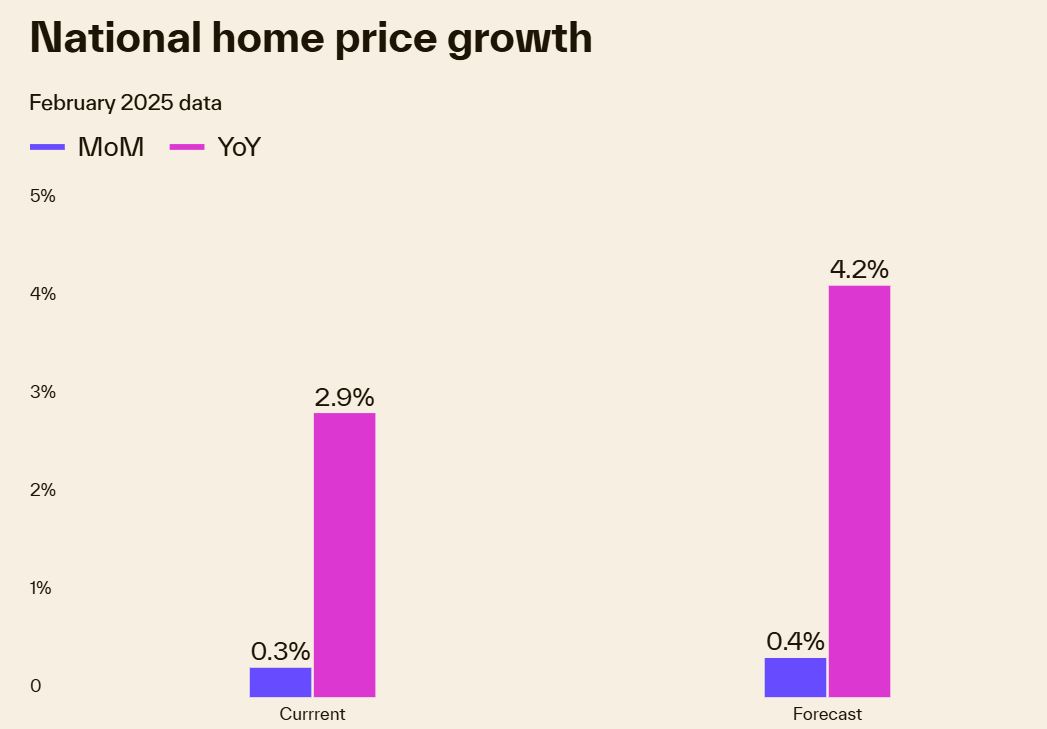
National home price growth
Source: Cotality

Despite these headwinds, the market isn't collapsing nationwide. The forecast still predicts year-over-year price growth, albeit at a more moderate pace (around +4.2% forecast from Feb 2025 to Feb 2026, compared to the current +2.9% YoY). This suggests a return to more normal, long-term average growth rather than a widespread crash.

However, real estate is intensely local. National averages smooth out the dramatic differences we see from state to state, and even city to city.

Why Some Markets Heat Up While Others Cool Down

It's fascinating to see the regional differences right now. Selma Hepp highlighted a key trend: the Northeast is still seeing strong price gains. Why? Primarily due to stronger income growth in that region combined with a severe, ongoing shortage of homes for sale. Basic supply and demand – lots of buyers competing for very few homes keeps prices high. Markets like Bridgeport, CT (+10.93%), Syracuse, NY (+9.33%), and New Haven, CT (+8.8%) are topping the “hottest markets” list.

On the flip side, areas in the Southeast and West are showing more signs of cooling. These regions often saw explosive growth during the pandemic boom. Now, they're experiencing more inventory growth (more homes hitting the market) and weakening demand. This leads to more sellers having to offer price discounts.

Florida is a prime example of this cooling trend. Several Florida cities dominate the “coolest markets” list, showing actual year-over-year price declines:

  • Cape Coral, FL: -4.5%
  • Sarasota, FL: -4.2%
  • Daytona, FL: -1.8%
  • Winter Haven, FL: -1%
  • Palm Bay, FL: -0.6%
  • Tampa, FL: -0.6%

Selma Hepp specifically mentioned that condominium prices have slowed, particularly as condo inventory in Florida continues to increase rapidly. This glut of supply, especially in certain segments, puts downward pressure on prices. From my perspective, this signals that the pandemic-era rush to sunshine states might be normalizing, and supply is finally starting to catch up, or even overshoot demand in some places.

Another interesting observation is the rise of places like Tennessee and South Carolina as retirement destinations. With median home prices around $335k and $332k respectively (still below the national median), they're attracting retirees looking for affordability, particularly those priced out of Florida. This influx, as noted, could change the character and affordability of these historically less expensive markets. It's a reminder that demographic shifts play a huge role in local housing trends.

Deep Dive: 5 Housing Markets with a Very High Risk of Price Crash

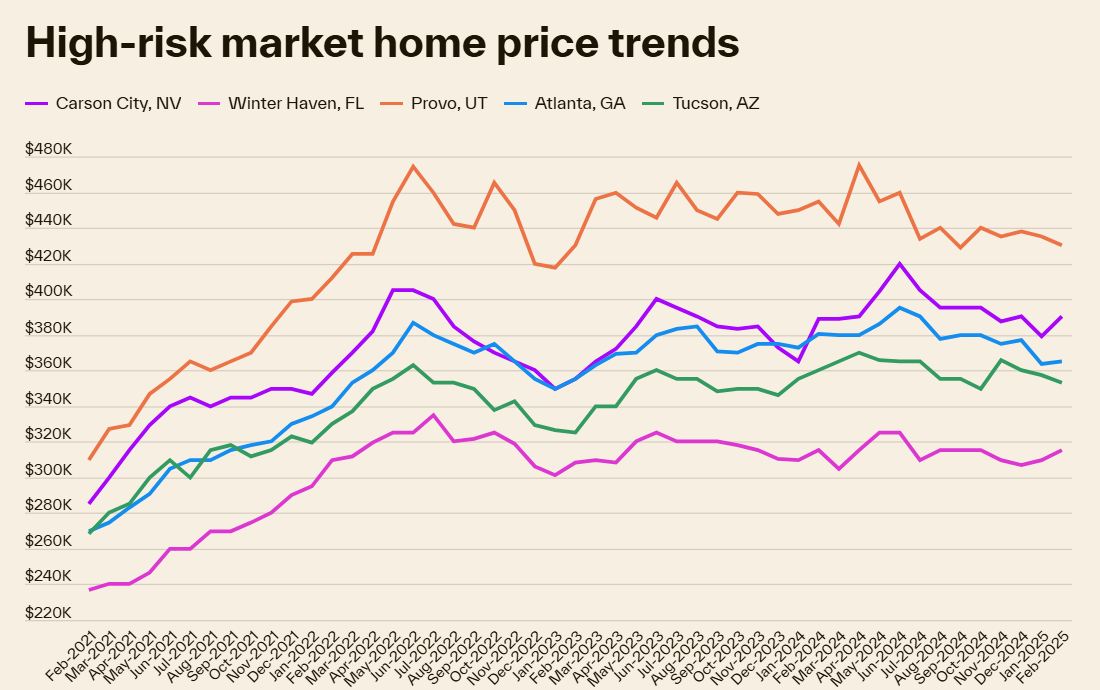
5 Housing Markets with a Very High Risk of Price Crash
Source: Cotality

Now, let's focus on the specific markets flagged by CoreLogic/Cotality as having a “very high risk” of price decline. It's important to understand what “high risk” means in this context. It doesn't automatically guarantee a massive crash like 2008. Instead, it indicates a significantly higher probability of seeing prices fall compared to the national average or lower-risk areas. This could manifest as a mild correction (say, 5-10% drop) or potentially something more substantial, depending on local economic factors and how significantly the market overheated.

Looking at the price trend graph provided for these five markets, a common pattern emerges: a sharp run-up in prices peaking sometime between early 2022 and mid-2024, followed by a noticeable plateau or downward drift. This visual story often points towards markets that experienced rapid appreciation, potentially becoming overvalued relative to local incomes, and are now facing a correction as demand cools and affordability bites.

Let's examine each one:

1. Carson City, NV

  • The Situation: Nevada's state capital saw significant price increases, likely benefiting from spillover demand from more expensive West Coast markets and its own appeal.
  • Price Trend Graph: The graph shows Carson City prices peaking around mid-2022 near the $400k mark, dipping, recovering somewhat through 2023, but then showing a distinct downward trend starting in mid-to-late 2024 and continuing into early 2025, settling below $380k.
  • My Take: Carson City's trajectory looks like a classic case of a smaller market getting caught up in a regional boom. Its peak coincided with the broader market frenzy. The subsequent decline suggests that the fundamentals (local wages, sustainable demand) might not fully support those peak prices, especially as higher interest rates impact affordability. Its proximity to California means it's sensitive to economic shifts there as well. The risk here seems tied to the potential unsustainability of its rapid price climb.

2. Winter Haven, FL

  • The Situation: Located in Central Florida between Tampa and Orlando, Winter Haven likely benefited from the massive influx into Florida seeking affordability relative to the coastal areas.
  • Price Trend Graph: Winter Haven's price journey shows a steady climb from early 2021, peaking later than Carson City, around early 2024 above $320k. However, a noticeable decline started shortly after, bringing prices down towards the $310k mark by early 2025. It's also already listed on the “coolest markets” with a -1% YoY change.
  • My Take: This aligns perfectly with the broader Florida cooling trend mentioned earlier, especially regarding rising inventory. Winter Haven was likely a destination for those priced out of larger Florida metros. As demand statewide cools and inventory (perhaps including those condos Selma Hepp mentioned) builds, markets like Winter Haven, which saw rapid appreciation, become vulnerable. The fact it's already showing negative year-over-year growth reinforces its position on this high-risk list. I suspect rising insurance costs in Florida might also be starting to weigh on buyer sentiment and affordability here.

3. Provo, UT

  • The Situation: The Provo-Orem area is known for its strong tech presence (“Silicon Slopes”) and younger demographic, factors that fueled incredible housing demand and price growth.
  • Price Trend Graph: Provo shows one of the most dramatic peaks on the graph, soaring well above $460k in early-to-mid 2022. The correction was equally sharp initially, followed by some volatility, but the overall trend since the peak has been downward, sitting closer to $420k by early 2025.
  • Price Trend Analysis: Provo's boom was intense. Such rapid growth often outpaces wage growth, creating an affordability crunch even with a strong local economy. The tech sector has also seen some volatility nationally, which could indirectly impact sentiment and high-end demand in Provo. The significant drop from its peak suggests the market was clearly overvalued, and the ongoing downward drift indicates the correction might not be over. This looks like a market needing to find a more sustainable price level.

4. Atlanta, GA

  • The Situation: Atlanta has been a major hub for growth, attracting businesses and residents alike, leading to substantial housing demand.
  • Price Trend Graph: Atlanta's price trend shows strong growth through 2021 and 2022, peaking around $380k-$390k in mid-2022. Since then, it's been more of a bumpy plateau with a slight downward tilt, particularly noticeable from late 2023 into early 2025, ending near the $360k mark.
  • Price Trend Analysis: Atlanta's risk profile might be slightly different. While it saw strong growth, its peak wasn't quite as sharp or its immediate drop as dramatic as Provo's. However, the persistent inability to regain its peak and the recent downward drift suggest weakening demand relative to supply. Factors could include affordability challenges creeping into this major metro and potentially slowing in-migration compared to the peak pandemic years. It feels like a market transitioning from hot growth to a cooling phase, making it vulnerable to price dips if economic headwinds pick up. My feeling is that affordability constraints are really starting to bite here.

5. Tucson, AZ

  • The Situation: Like many Sun Belt cities, Tucson experienced a surge in popularity and home prices, attracting buyers seeking sunshine and relatively lower costs compared to California or even Phoenix.
  • Price Trend Graph: Tucson's graph shows a steady climb, peaking later than some others, around early 2024, near $370k. Similar to Winter Haven, the decline started relatively recently but appears consistent, bringing prices down towards $350k by early 2025.
  • Price Trend Analysis: Tucson's recent peak and subsequent decline suggest the tail end of the boom might have pushed prices beyond what the local market can sustain long-term. As affordability pressures mount nationally and migration patterns potentially shift again, markets like Tucson that saw rapid, recent appreciation become prime candidates for a correction. The risk here feels tied to the possibility that the recent price levels were driven more by temporary pandemic-era demand shifts than by underlying long-term economic fundamentals. It’s a market to watch closely to see if this downward trend accelerates.

What Does “High Risk” Really Mean for You?

Hearing “high risk of price crash” can be scary, especially if you own a home in one of these areas or are considering buying there. Let's put it in perspective:

  • Correction vs. Crash: A correction typically involves a price decline of around 10%, maybe up to 20% in some cases. It's a market resetting after a period of being overvalued. A crash, like we saw after 2007, involves much steeper, faster declines (20%+) often accompanied by widespread foreclosures and economic distress. While these 5 markets have a higher risk of decline, most economists aren't forecasting a 2008-style crash across the board. The lending standards today are much stricter than they were back then.
  • It's About Probability: This list identifies markets where the chances of prices falling are higher than elsewhere. It's not a guarantee. Local economic developments, shifts in inventory, or changes in interest rates could alter the trajectory.
  • Focus on the Long Term: If you bought a home recently at peak prices in one of these areas, seeing values dip isn't fun. But if you plan to live there for many years (say, 7-10+), housing markets tend to recover and appreciate over the long haul. Short-term fluctuations matter most if you need to sell soon.
  • Opportunity for Buyers? For potential buyers, falling prices can be an opportunity if you have stable finances and plan to stay put. However, trying to perfectly “time the bottom” is notoriously difficult and risky. Buying a home you can comfortably afford in a location you love is always the best strategy.

Factors I'm Watching Closely (Beyond These 5 Markets)

Whether you're in a high-risk zone or not, here are the key indicators I always keep an eye on to gauge market health:

  • Inventory Levels: Are more homes hitting the market (rising inventory)? Are they selling quickly, or sitting longer? A sustained rise in inventory, especially if sales slow, points to potential price drops. The data showing rising condo inventory in Florida is a perfect example.
  • Days on Market (DOM): How long does it take for a home to go under contract? If DOM starts stretching out significantly, it means buyers are becoming more hesitant or have more options.
  • Price Reductions: Are sellers increasingly having to lower their asking price to attract offers? Tracking the percentage of listings with price cuts is a great real-time indicator of market softness. The data mentioned more price discounts in the Southeast and West – a clear sign of cooling.
  • Mortgage Rates: Even small changes impact affordability. Keep an eye on the general trend. Sustained higher rates will continue to pressure demand.
  • Local Job Market: A strong local economy supports housing demand. Conversely, significant local layoffs can quickly cool a housing market.

Looking at the “Coolest Markets” list again – Cape Coral, Sarasota, San Francisco, Daytona, Winter Haven, Austin, Dallas, Palm Bay, Tampa, Oakland – it reinforces that the cooling isn't isolated to just the 5 “highest risk” areas. Many markets, particularly former pandemic boomtowns in Florida and Texas, along with expensive coastal areas like California, are already experiencing mild price declines.

My Final Thoughts

The US housing market is definitely navigating a complex transition. The days of easy double-digit annual gains are likely behind us for most areas. While a nationwide crash seems unlikely due to stricter lending and ongoing supply shortages in many regions, the risk of price declines is very real in specific, overheated markets.

The identification of Carson City, Winter Haven, Provo, Atlanta, and Tucson as the 5 housing markets with a very high risk of price crash serves as a crucial warning sign. These markets appear to share common threads: rapid price appreciation during the boom, potential overvaluation relative to local incomes, and now signs of cooling demand or rising inventory as affordability bites and pandemic-era trends normalize.

My advice? If you're in one of these markets, or frankly anywhere, stay informed about your local conditions. National headlines provide context, but real estate is hyperlocal. Pay attention to inventory, days on market, and price reductions in your specific neighborhood. If you're buying, ensure you're purchasing a home you can truly afford for the long haul, not speculating on short-term gains. If you're selling, be realistic about pricing based on current market conditions.

The housing market requires a more cautious and informed approach today than it did two years ago. Understanding the risks, especially in identified hotspots, is the first step toward making smart decisions.

Work with Norada, Your Trusted Source for

Real Estate Investment in the Top U.S. Markets

Discover high-quality, ready-to-rent properties designed to deliver consistent returns.

Contact us today to expand your real estate portfolio with confidence.

Contact our investment counselors (No Obligation):

(800) 611-3060

Get Started Now 

Also Read:

  • Housing Markets Predicted to Crash by Double Digits by Q1 2026
  • Real Estate Forecast: Will Home Prices Bottom Out in 2025?
  • Housing Markets With the Biggest Decline in Home Prices Since 2024
  • Why Real Estate Can Thrive During Tariffs Led Economic Uncertainty
  • Rise of AI-Powered Hyperlocal Real Estate Marketing in 2025
  • Real Estate Forecast Next 5 Years: Top 5 Predictions for Future
  • 5 Hottest Real Estate Markets for Buyers & Investors in 2025
  • Will Real Estate Rebound in 2025: Top Predictions by Experts
  • Recession in Real Estate: Smart Ways to Profit in a Down Market
  • Will There Be a Real Estate Recession in 2025: A Forecast
  • Will the Housing Market Crash Due to Looming Recession in 2025?
  • 4 States Facing the Major Housing Market Crash or Correction
  • New Tariffs Could Trigger Housing Market Slowdown in 2025
  • Real Estate Forecast Next 10 Years: Will Prices Skyrocket?

Filed Under: Housing Market, Real Estate Market Tagged With: Home Price Drop, home prices, Housing Market, real estate, Real Estate Market

Why Are Mortgage Rates Rising Back to 7%: The Key Drivers

April 22, 2025 by Marco Santarelli

Why Are Mortgage Rates Rising Back to 7%: The Key Drivers

Are you in the market for a new home, or thinking about refinancing? If so, you've probably been watching mortgage rates like a hawk. The bad news? As of April 22, 2025, the average 30-year fixed mortgage rate has indeed crept back up, hovering just under 7.00%. Let's explore the reasons behind this increase, what it means for you, and what you can expect in the coming months.

Why Are Mortgage Rates Rising Back to 7%: The Key Drivers

Recent Mortgage Rate Trends: A Rollercoaster Ride

Mortgage rates have been anything but predictable lately. 2025 has been a year of ups and downs, influenced by a tricky mix of what's happening in politics and the economy.

Here’s a quick recap of what we’ve seen:

  • Early 2025: Rates peaked at around 7.04% in January.
  • February/March 2025: There was a bit of relief as rates dipped into the mid-6% range.
  • April 2025 (so far): Unfortunately, that dip was short-lived. We’re now seeing rates climb back toward that 7% mark.

Let’s break down some numbers to get a clearer picture:

Source Date Rate Points Change from Prior Week Prior Year YOY Change
Mortgage News Daily April 22, 2025 6.98% — +0.00% 7.43% -0.45%
Mortgage News Daily April 17, 2025 6.87% — +0.01% 7.41% -0.54%
Mortgage News Daily April 15, 2025 6.88% — -0.10% 7.44% -0.56%
MBA 30 Year Fixed April 16, 2025 6.81% 0.62 +0.20% 7.01% -0.20%
Freddie Mac 30 Year Fixed April 17, 2025 6.83% 0.00 +0.21% 6.88% -0.05%

Why Are Mortgage Rates Rising? The Key Drivers

So, what's behind this recent climb in mortgage rates? It's not just one thing, but rather a combination of factors that are making lenders a little more cautious.

1. Political Uncertainty and the Fed

One big factor is the political climate. Lately, there's been some criticism aimed at the Federal Reserve (the Fed) and its chairman. This has made investors nervous because it raises questions about how independent the Fed really is. The Fed's job is to manage the economy by controlling interest rates and making sure things stay stable. If people start to think the Fed might be influenced by politics, they get worried, and that can affect the markets, pushing interest rates (including mortgage rates) higher.

2. Tariff Troubles and Inflation Fears

Another key driver is the ongoing issue of tariffs (taxes on imported goods). Recently, there have been announcements about tariffs on goods coming from other countries. This can lead to inflation because when things cost more to import, businesses often pass those costs on to consumers in the form of higher prices. Higher inflation makes the Fed more likely to keep interest rates high, which in turn keeps mortgage rates high.

3. Stubborn Inflation: A Lingering Problem

Even though we saw some signs of inflation cooling down earlier in the year, recent data shows that core inflation is still hanging around. This is a problem because the Fed is really focused on getting inflation under control. As long as inflation remains a concern, we're likely to see upward pressure on Treasury yields, which directly impact mortgage rates.

4. The Bond Market Connection

Mortgage rates are closely linked to something called the 10-year Treasury note yield. Think of it this way: when the yield on these Treasury notes goes up, mortgage rates usually follow. In recent weeks, those Treasury yields have been rising due to the political uncertainty, inflation worries, and tariff policies I mentioned earlier. It's all connected!

What Does This Mean for the Housing Market?

Okay, so rates are rising. But what does that really mean for you and the housing market as a whole? Here's the breakdown:

1. Affordability Takes a Hit

Plain and simple: higher mortgage rates make buying a home more expensive. Even a small increase in the rate can add up to a significant amount over the life of a 30-year loan.

Here's an example:

  • A $340,000 loan at 6.5% interest has a monthly payment of about $2,150.
  • That same loan at 7% interest jumps to around $2,280 per month.

That extra $130 per month can make a big difference, especially for first-time homebuyers or those on a tight budget. It could even price some people out of the market altogether.

2. Market Activity: A Potential Slowdown

Despite the recent rate hikes, the spring homebuying season has shown some strength. However, if rates stay high or continue to climb, we could see a slowdown in home sales. Some potential buyers might decide to wait and see if rates come down before making a move.

3. Refinancing Dries Up

If you already have a mortgage with a lower interest rate, you're probably not going to be too excited about refinancing at today's higher rates. This means that refinancing activity will likely decrease, which can impact lenders and the mortgage market as a whole.

4. Investors Get More Cautious

Investors in the housing market might also start to rethink their strategies. Higher borrowing costs could lead to more conservative investment decisions, which could affect rental prices and the overall supply of homes.

Read More:

Mortgage Rate Forecast 2025: When Will Rates Go Below 6%?

Mortgage Rates Likely to Go Down in the Short Term Due to Tariffs

What's the Outlook for the Rest of 2025?

Predicting the future is always tricky, but here's what some experts are saying about mortgage rates for the rest of 2025:

  • Fannie Mae: They're predicting that 30-year mortgage rates will end the year around 6.3%.
  • Other Experts: Some are expecting rates to stay between 6.5% and 7% for the next couple of years, citing ongoing political and economic uncertainty.

Here are some things that could influence where rates go from here:

  • Economic Slowdown: If the economy starts to cool down and inflation eases, we could see rates decrease.
  • Federal Reserve Actions: The Fed has hinted at the possibility of cutting interest rates in 2025. If they do, that could give mortgage rates a downward push.
  • Global Events: Unexpected events around the world (like trade wars or political instability) could create more volatility and keep rates elevated.

My Personal Take and Advice

From my experience in the market, I believe that the best approach is always to prioritize your financial goals over trying to time the market. If you have a solid financial foundation and you've found a home you love, don't let fluctuating interest rates paralyze you. Consult with a mortgage professional who can provide tailored advice based on your specific situation. Locking in a rate now might be a good move, while others might prefer to wait for potential rate decreases later in the year. The right decision will depend on your risk tolerance and financial objectives.

In Conclusion

The recent rise in mortgage rates is definitely something to pay attention to. It’s a reminder that the housing market is constantly influenced by economic and political factors. While the future is uncertain, staying informed, understanding your own financial situation, and working with trusted professionals will put you in the best position to make smart decisions, whether you're buying, selling, or just keeping an eye on the market.

Work With Norada, Your Trusted Source for

Real Estate Investment in the U.S.

Investing in turnkey real estate can help you secure consistent returns with fluctuating mortgage rates.

Expand your portfolio confidently, even in a shifting interest rate environment.

Speak with our expert investment counselors (No Obligation):

(800) 611-3060

Get Started Now

Also Read:

  • Will Mortgage Rates Go Down in 2025: Morgan Stanley's Forecast
  • Expect High Mortgage Rates Until 2026: Fannie Mae's 2-Year Forecast
  • Mortgage Rate Predictions 2025 from 4 Leading Housing Experts
  • Mortgage Rates Forecast for the Next 3 Years: 2025 to 2027
  • 30-Year Mortgage Rate Forecast for the Next 5 Years
  • 15-Year Mortgage Rate Forecast for the Next 5 Years
  • Why Are Mortgage Rates Going Up in 2025: Will Rates Drop?
  • Why Are Mortgage Rates So High and Predictions for 2025
  • Will Mortgage Rates Ever Be 3% Again in the Future?
  • Mortgage Rates Predictions for Next 2 Years
  • Mortgage Rate Predictions for Next 5 Years
  • Mortgage Rate Predictions: Why 2% and 3% Rates are Out of Reach
  • How Lower Mortgage Rates Can Save You Thousands?
  • How to Get a Low Mortgage Interest Rate?
  • Will Mortgage Rates Ever Be 4% Again?

Filed Under: Financing, Mortgage Tagged With: Interest Rate, mortgage, Mortgage Rate Trends, mortgage rates, Mortgage Rates Predictions, Mortgage Rates Today

  • « Previous Page
  • 1
  • …
  • 180
  • 181
  • 182
  • 183
  • 184
  • …
  • 379
  • Next Page »

Real Estate

  • Birmingham
  • Cape Coral
  • Charlotte
  • Chicago

Quick Links

  • Markets
  • Membership
  • Notes
  • Contact Us

Blog Posts

  • Today’s Mortgage Rates, July 29: Rates Climb to 6.69%, But Home Purchase Applications Rise 6%
    July 29, 2026Marco Santarelli
  • Why Buyers Are Rushing to Lock In Before Mortgage Rates Hit 7%
    July 29, 2026Marco Santarelli
  • Best Cities to Buy a Duplex or Triplex for Rental Income in 2026
    July 29, 2026Marco Santarelli

Contact

Norada Real Estate Investments 30251 Golden Lantern, Suite E-261 Laguna Niguel, CA 92677

(949) 218-6668
(800) 611-3060
BBB
  • Terms of Use
  • |
  • Privacy Policy
  • |
  • Testimonials
  • |
  • Suggestions?
  • |
  • Home

Copyright 2018 Norada Real Estate Investments

Loading...