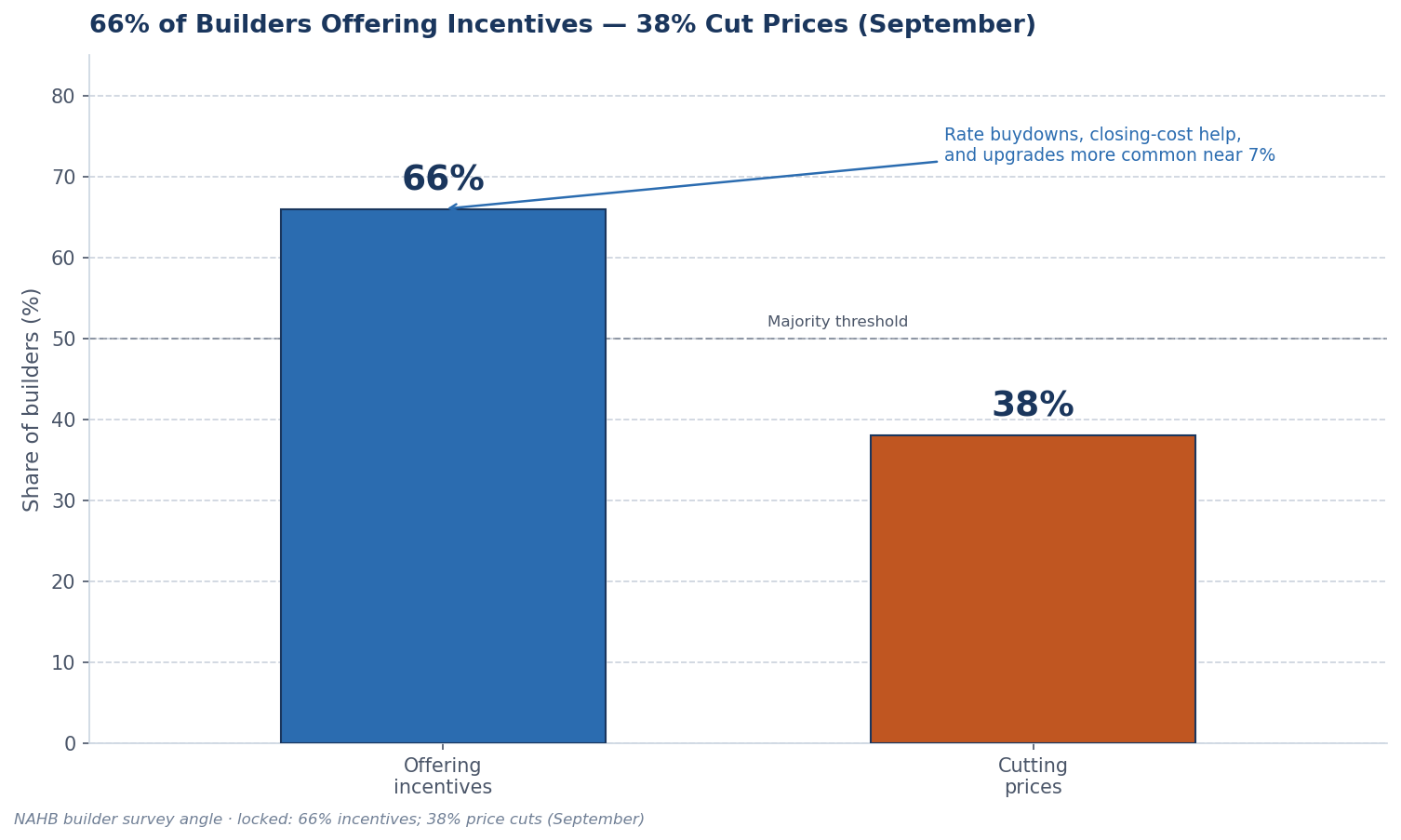
Builders are not waiting for mortgage rates to magically fall: in September survey snapshots, about 66% are offering incentives and 38% report cutting prices. If you are shopping new construction while 30-year quotes sit near 7%, that is your opening — a chance to negotiate payment help and upgrades rather than assuming the brochure price is the real price.
The backdrop is familiar and firm: existing sales soft near a 14-month low, inventory near 1.62 million with about 4.9 months’ supply, builder sentiment at an HMI of 32, and a Fed funds range of 3.75%–4.00% after a unanimous +25 bp hike under Chair Kevin Warsh (SEP median ~4.1% end-2026). For sentiment detail, see builder confidence at a 12-month low. For how to use leverage on both new and resale, see negotiating power in fall 2026.
66% of Builders Are Offering Incentives — and 38% Cut Home Prices in September
Incentives vs. Price Cuts: Why Builders Prefer the Menu
A sticker-price cut is blunt. It can pressure appraisals across a community and annoy earlier buyers who paid more. Incentives — rate buydowns, closing-cost help, design credits, appliance packages, HOA payments — can manufacture a workable monthly payment while keeping the published base price steadier. That is why you often see a majority offering incentives even when a smaller share reports outright cuts.
- ~66% of builders offering incentives (September survey context)
- ~38% cutting prices
- Rate backdrop: 30-year fixed surveys ~7.00%–7.08%; some quotes higher
- HMI backdrop: 32, a 12-month low
As a shopper, translate every incentive into dollars per month and cash-to-close. A dazzling design credit that you did not need may be worth less than a quieter rate buydown that you did.
The Incentive Menu You Should Ask For in Writing
Sales offices sometimes lead with the flashiest perk. You want the full list:
- Permanent points that lower the note rate for the life of the loan (or until you refinance)
- Temporary buydowns such as a 2-1 buydown that reduce payments in years one and two
- Closing-cost credits that protect cash reserves
- Upgrades and options at reduced or zero incremental cost
- HOA or landscaping credits that lower near-term carrying costs
- Rate-lock extensions or float-down language if your build timeline is long
Get it in the purchase agreement, not only in a verbal pitch. Confirm whether preferred-lender incentives require using the builder’s lender — and compare that quote with at least one outside lender before you commit.
| Tool | What it helps | Question to ask |
|---|---|---|
| Permanent points | Lower payment for the life of the note | How many points, and who pays? |
| 2-1 buydown | Lower payments in years 1–2 | What happens in year 3 at the note rate? |
| Closing credit | Cash-to-close | Any loan-program caps? |
| Price cut | Lower basis and sometimes payment | Will appraisal and community pricing hold? |
| Options credit | Finishes without stretching budget | Is it transferable if I change packages? |
How to Compare New Construction With Resale Fairly
Do not compare brochure price to list price and stop. Build one worksheet that includes principal and interest at the actual quoted rate, taxes, insurance, HOA, and any temporary buydown schedule. Then compare a incentivized new home with a resale where you might negotiate credits of your own.
Resale inventory near 1.62 million and ~4.9 months’ supply means you have alternatives (inventory and months’ supply). Builders know that. Your calm ability to walk across the street — literally or figuratively — is part of your leverage.
Also underwrite differences in property condition, energy efficiency, builder warranties, and location. A cheaper payment on a new home can still be the wrong buy if commute, schools, or insurance quotes do not work. Speaking of insurance: treat premiums as a first-class input, not an afterthought (insurance raising the real monthly payment).
Preferred Lenders, Capture, and Shopping Discipline
Builder incentives often look richest when you use an affiliated lender. Sometimes that package is genuinely best. Sometimes an outside lender’s rate plus a renegotiated credit wins. The only way to know is to compare loan estimates side by side on the same day, with the same credit profile assumptions.
- Ask what incentive vanishes if you bring your own lender.
- Compare APR, points, origination fees, and lock terms — not only the headline rate.
- If you qualify, check whether FHA or VA channels change the payment enough to alter the incentive math.
- For adjustable options, see 5/1 ARM vs 30-year fixed before you chase a teaser.
Why Price Cuts Still Matter — Even at 38%
When more than a third of builders report cutting prices, some communities are clearing inventory the old-fashioned way. That can create opportunities on standing inventory (specs and quick move-ins) where carrying costs hurt the builder most. Ask which homes are prioritized for discounts and whether further negotiation is possible as the month ends or as quarter-end targets approach.
Be kind but firm. Sales teams have goals; you have a budget. Meeting in the middle with a documented package beats hardball theatrics that waste a Saturday.
Sellers of Existing Homes: This Is Your Competition
If you are listing a resale, pretend you are shopping against the nearest active adult or family community. What payment can a buyer get there after incentives? If your home cannot win on location, condition, or uniqueness, you may need credits of your own. Quiet existing sales (14-month low in sales) mean you are competing for a smaller set of qualified households.
Timing Tactics: Specs, Quick Move-Ins, and To-Be-Builts
Standing inventory (specs and quick move-ins) usually carries the richest discounts because the builder is paying interest, taxes, and utilities now. To-be-built homes may offer fewer dramatic cuts but more customization — and more rate risk across a longer construction timeline. Match the product to your urgency. If you must move in 60 days, lean into specs and negotiate hard. If you can wait, a to-be-built with a strong permanent buydown may produce a better long-run payment.
For long builds, clarify what happens if market rates rise before you lock, and whether any incentive is tied to a lock deadline. The Fed’s path toward a year-end median near ~4.1% is not a promise of another hike, but it is a reminder not to assume financing gets easier automatically mid-build.
A Simple Negotiation Script That Feels Human
You do not need theatrical toughness. Try something closer to: “We love the home. At today’s rate near 7%, the payment only works if we can improve the buydown or closing help. We are comparing a resale with credits and your community’s package — can we look at one more revision on lot 42?” That tone recognizes the salesperson’s reality and still asks for the business outcome you need. Soft demand nationally — including weak purchase applications — means good closers are scarce. Be one of them, and ask clearly.
Bottom Line
With roughly 66% of builders offering incentives and 38% cutting prices in September, new construction is one of the more negotiable corners of a market still constrained by ~7% mortgage rates and a Fed stance at 3.75%–4.00%. Translate every perk into monthly payment and cash-to-close, compare against resale with the same worksheet, and put the winning package in writing. Soft sentiment and soft demand created the menu — your job is to order carefully.
VS
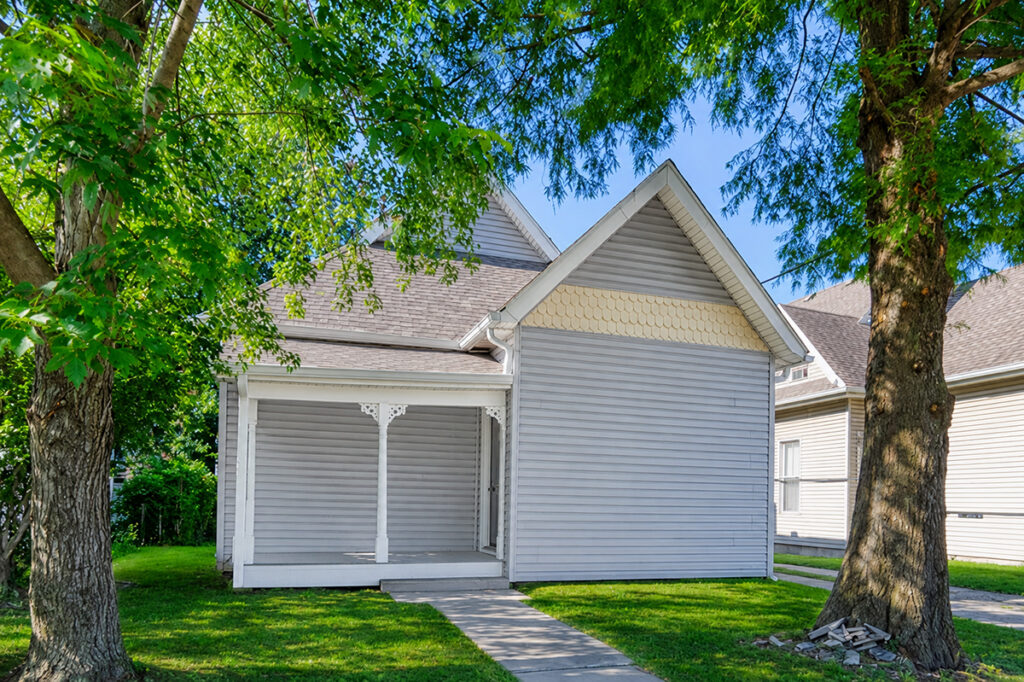
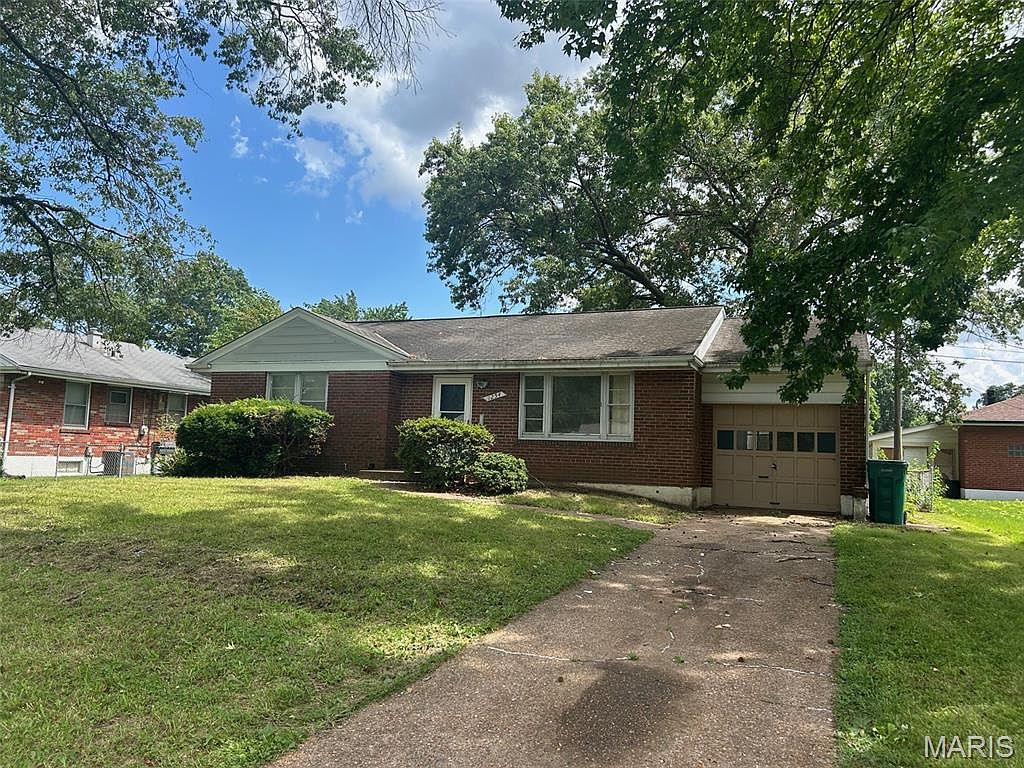
Saint Louis offers a budget‑friendly 4‑bed rental with a high cap rate, while Indianapolis provides a classic 2‑bed property with steady cash flow. Which Midwest market fits YOUR investment strategy?
We have much more inventory available than what you see on our website – Let us know about your requirement.
📈 Choose Your Winner & Contact Us Today!
Speak to a Norada Investment Counselor (No Obligation):
(800) 611-3060
Also Read:
- Top 10 Housing Markets Set to Deliver High ROI in 2026
- Top 10 Most Popular Housing Markets of 2025 for Homebuyers
- Will Real Estate Rebound in 2026: Top Predictions by Experts
- Housing Market Predictions for the Next 4 Years: 2026, 2027, 2028, 2029
- Housing Market Predictions for 2026 Show a Modest Price Rise of 1.2%
- Housing Market Predictions 2026 for Buyers, Sellers, and Renters
- 12 Housing Markets Set for Double-Digit Price Decline by Early 2026
- Real Estate Forecast: Will Home Prices Bottom Out in 2025?
- Housing Markets With the Biggest Decline in Home Prices Since 2024
- Why Real Estate Can Thrive During Tariffs Led Economic Uncertainty
- Rise of AI-Powered Hyperlocal Real Estate Marketing in 2025
- Real Estate Forecast Next 5 Years: Top 5 Predictions for Future
- 5 Hottest Real Estate Markets for Buyers & Investors in 2025