
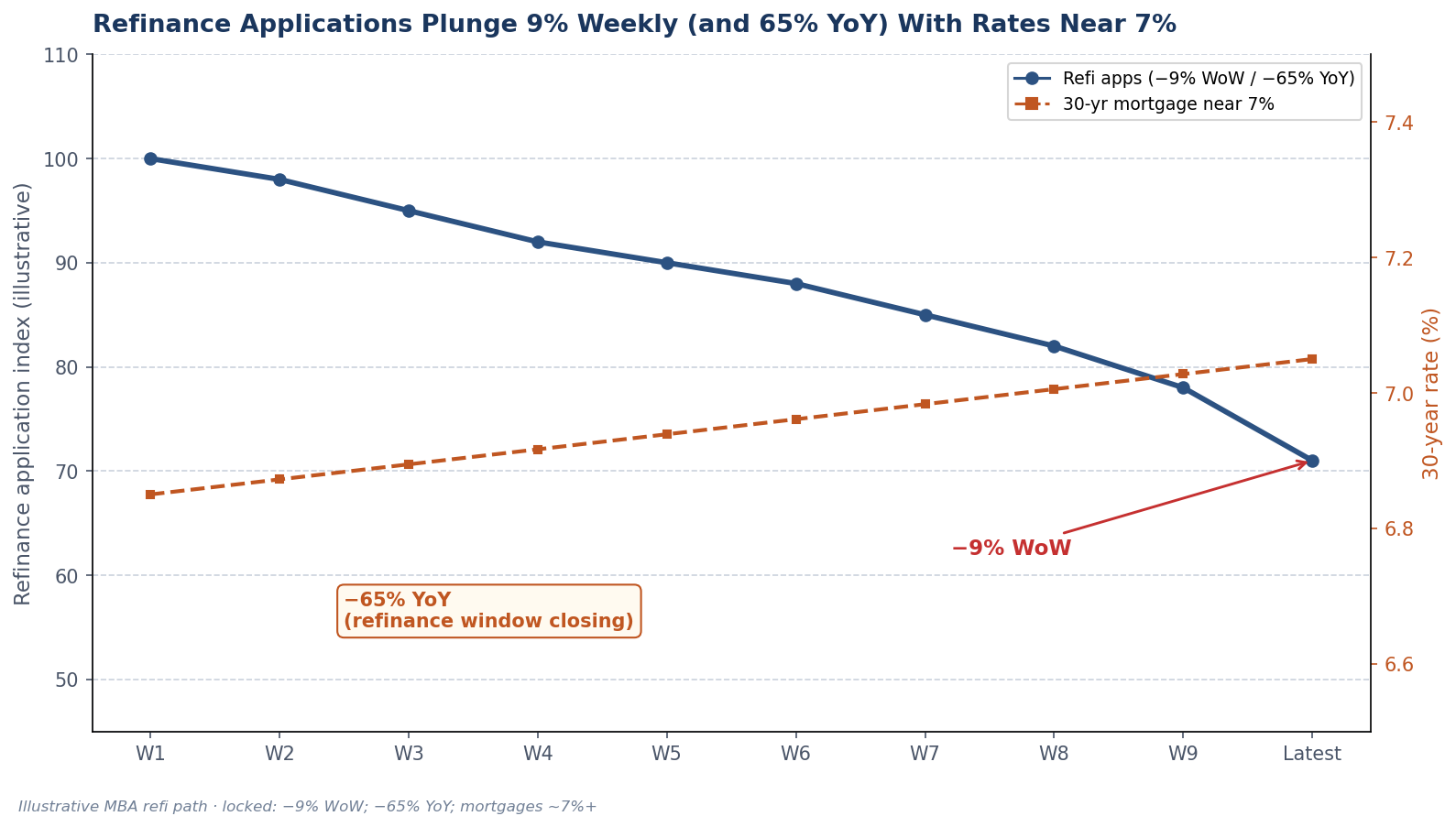
Refinance activity just took another step down: applications fell about 9% week over week and remain roughly 65% lower than a year ago while 30-year mortgage rates sit near 7%. If you have been waiting for a broad refi wave, this is the market telling you — politely but firmly — that the window is mostly closed for rate-and-term deals.
That should not shock anyone watching coupons. When surveys print around 7.00%–7.08% (with some sources higher) and the Fed has just hiked to 3.75%–4.00% unanimously under Chair Kevin Warsh, few households with 3%–5% notes can justify refinancing for rate alone. For the purchase side of demand, see mortgage applications and purchase weakness. For why rates were already near 7% pre-meeting, see oil, yields, and inflation expectations.
Refinance Applications Plunge 9% Weekly (and 65% Year Over Year) With Mortgage Rates Near 7%
Why Refi Volumes Collapse When Rates Sit Near 7%
Refinance applications surge when borrowers can lower their rate enough to beat closing costs inside a sensible break-even period. At near-7% quotes, that arithmetic fails for the huge cohort that locked much lower during 2020–2022. Some borrowers still refinance for cash-out, debt consolidation, or to drop mortgage insurance — but pure rate refis become rare, and weekly volumes swing on a smaller base.
- Refi apps: about -9% week over week
- Refi apps: about -65% year over year
- Rate backdrop: 30-year fixed near 7% (surveys ~7.00%–7.08%; some higher)
- Policy backdrop: fed funds 3.75%–4.00%; SEP median ~4.1% end-2026
Rate-and-Term vs. Cash-Out: Different Questions
A rate-and-term refinance asks: will my new payment and costs beat my current note? For most low-coupon borrowers, the answer is no at ~7%. A cash-out refinance asks a different question: do I need liquidity badly enough to accept a higher blended cost of capital? That bar is personal. Sometimes a cash-out still loses to a HELOC — though HELOC pricing is also firmer after the Fed’s hike (HELOC rates after +25 bp)
| Goal | Often makes sense when… | Often fails when… |
|---|---|---|
| Rate-and-term | Your current rate is near or above today’s quotes | You hold a much lower coupon |
| Cash-out | Liquidity need is high and alternatives are worse | You are stretching to fund wants, not needs |
| Streamline / program refi | You qualify for a unique lower-friction path | Fees and rate still do not clear break-even |
| HELOC / second lien | You want to keep a low first mortgage | Variable rates or tight credit make it costly |
Break-Even Math You Should Actually Run
Before you chase a refinance quote out of habit, write down:
- Current rate, balance, and remaining term
- New rate, points, title/escrow fees, and lender charges
- Monthly payment change
- Months to recover costs (and probability you move before then)
If break-even stretches beyond your likely hold period, stop. Soft weekly refi prints are not a personal insult — they are the aggregate of millions of households doing some version of that math and walking away.
Who Might Still Refinance in This Tape
- Borrowers with adjustable rates resetting higher
- Homeowners who bought or refinanced already near today’s rate and can improve with better credit or lower points
- FHA/VA borrowers who may find program-specific paths worth checking (FHA and VA vs conventional)
- Households consolidating high-interest consumer debt — carefully, after counseling the risk of putting short-term debt on the house
What the Plunge Means for Housing Turnover
Depressed refinance activity is a cousin of lock-in. Owners who cannot improve their rate are also reluctant to sell and rebuy at ~7%, which limits existing-home supply from that cohort even as overall inventory has rebuilt toward 1.62 million and ~4.9 months’ supply (inventory backdrop). The households who do list are often more motivated — which feeds buyer negotiating power.
Builders cannot refinance your emotions, but they can buy down a new-home rate. That is one reason incentives remain widespread while refinance channels look barren (builder incentives and price cuts).
Fed Path and the “Maybe Later” Trap
The SEP median near ~4.1% for the funds rate by end-2026 leaves room for roughly another firming step if inflation stays sticky. That is not a forecast that mortgages go to 8% tomorrow — mortgages are not one-for-one with fed funds — but it does caution against assuming a swift return to mid-5% refinance heaven. If your plan requires a refi to make a purchase work, you are underwriting hope. Consider structures that work at today’s note rate, including seller/builder credits or a 2-1 buydown with eyes open about year-three payment.
Practical Alternatives If a Refi Does Not Clear
- Keep the low first mortgage and evaluate a smaller HELOC for a defined project
- Recast (if your servicer allows) after a principal curtailment
- Negotiate purchase credits instead of assuming a post-closing refi
- Delay nonessential cash-out that would reset your rate higher
Cash-Out Caution in a Near-7% World
Cash-out refinance volume can hold up better than rate refis in some cycles because needs do not disappear when coupons rise. Still, putting new higher-rate debt against your home deserves extra humility. Ask whether a smaller HELOC, a temporary personal loan for a defined project, or simply delaying the spend is safer. If you do cash out, keep a reserve for insurance and tax resets — escrow shocks are already biting many households (insurance as a payment shock).
Also beware of “refi to invest” pitches that assume home prices only rise. Soft existing sales and rebuilding inventory mean liquidity is not instant everywhere. Your home is shelter first; it is not an ATM with free money.
What a -65% YoY Refi Print Says About Lock-In
A year-over-year plunge near 65% is another way of measuring how many borrowers are simply done with the refinance channel until rates fall enough to matter. That lock-in reduces move-up activity and helps explain why sales can stay near a 14-month low even as listings slowly rebuild. Policy makers watching housing will notice; households making personal decisions should notice too. If your plan requires both selling and rebuying, underwrite the new payment at today’s quotes and negotiate accordingly — including credits that mimic a mini-refi at purchase through points or a buydown.
Servicer Conversations Worth Having Anyway
Even when a full refinance fails the math, call your servicer about options that sometimes get overlooked: recast after a lump-sum principal payment, temporary forbearance only if you truly need hardship help, or automated payment reviews that catch escrow errors. None of those is a substitute for a 150 bp rate cut that does not exist today — but fixing an escrow mistake or recasting after an inheritance payment can still lower the monthly bill without a new note at 7%.
If you are an investor with multiple properties, map which loans are adjustable or maturing soon. The refinance desert is less about “housing is dead” and more about coupon math. Plan capital expenditures and cash reserves accordingly while purchase demand remains soft (MBA purchase apps weak YoY).
Bottom Line
Refinance applications down about 9% week over week and about 65% year over year are what a near-7% mortgage market looks like in the data — especially after a Fed hike to 3.75%–4.00% keeps the “easy money soon” narrative in check. Run break-even math, do not refinance out of FOMO, and if you need a lower payment to buy, negotiate the payment in the purchase rather than assuming a future refi will rescue the deal.

VS
Out‑of‑State investors can compare Tennessee’s newer rental with higher NOI vs Florida’s A+ property with strong yield. Which fits YOUR investment strategy?
We have much more inventory available than what you see on our website – Let us know about your requirement.
📈 Choose Your Winner & Contact Us Today!
Speak to a Norada Investment Counselor (No Obligation):
(800) 611-3060
Mortgage rates remain high in 2026, but rental properties continue to deliver strong cash flow and appreciation. Savvy investors know that turnkey real estate is the path to passive income and long‑term wealth.
Norada Real Estate helps you secure turnkey rental properties designed for immediate cash flow and appreciation—so you can invest smartly regardless of interest rate trends.
Also Read:
- Mortgage Rates Predictions Backed by 7 Leading Experts: 2025–2026
- Mortgage Rate Predictions for the Next 3 Years: 2026, 2027, 2028
- 30-Year Fixed Mortgage Rate Forecast for the Next 5 Years
- 15-Year Fixed Mortgage Rate Predictions for Next 5 Years: 2025-2029
- Will Mortgage Rates Ever Be 3% Again in the Future?
- Mortgage Rates Predictions for Next 2 Years
- Mortgage Rate Predictions for Next 5 Years
- Mortgage Rate Predictions: Why 2% and 3% Rates are Out of Reach
- How Lower Mortgage Rates Can Save You Thousands?
- How to Get a Low Mortgage Interest Rate?
- Will Mortgage Rates Ever Be 4% Again?