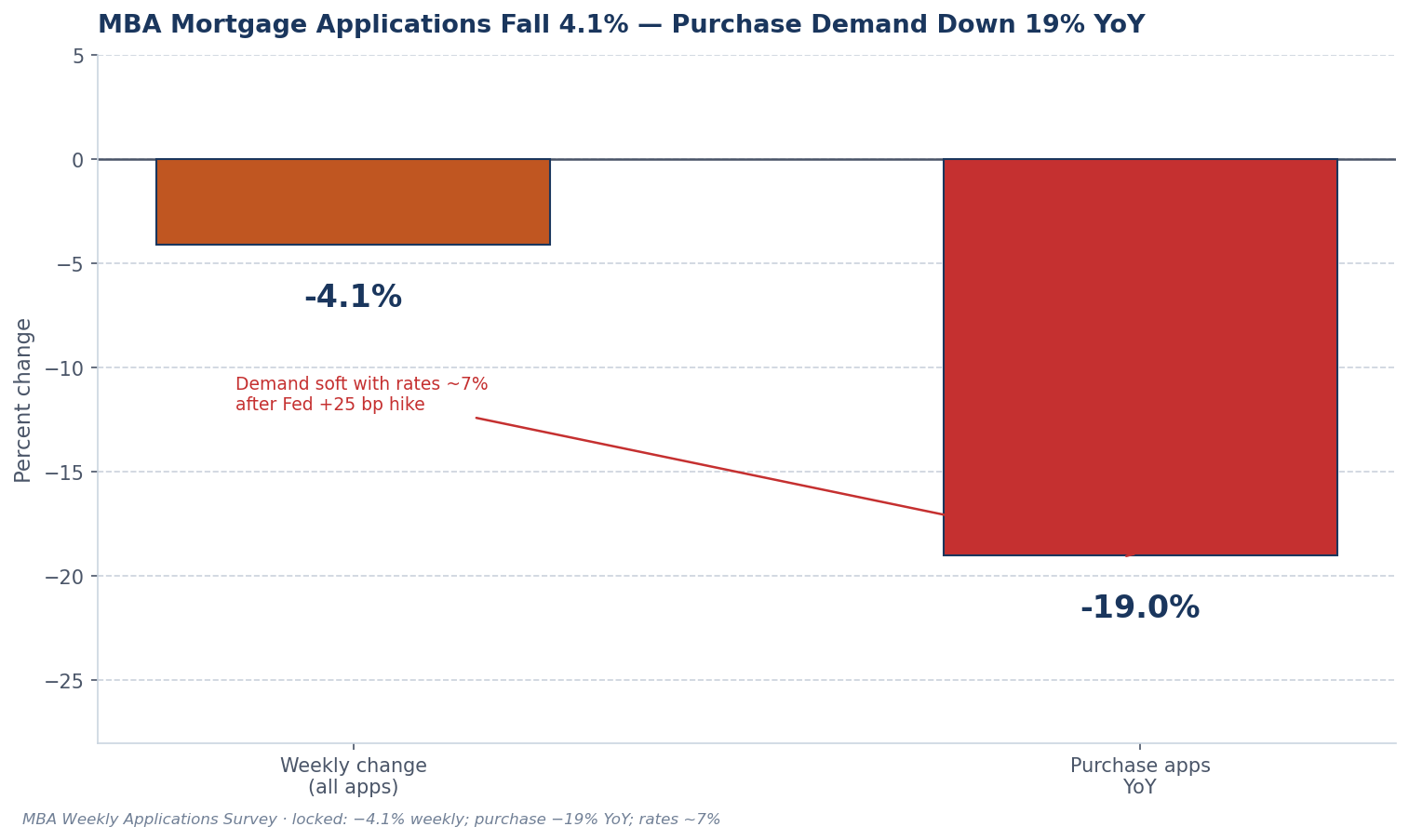
Mortgage demand cooled again: total applications fell about 4.1% in the latest MBA weekly read, while purchase applications run roughly 19% lower than a year ago. That is the lender-pipeline version of what housing already shows in soft existing sales and cautious builders — buyers are still choking on payments near 7%.
The Fed’s unanimous +25 bp hike to 3.75%–4.00% under Chair Kevin Warsh (SEP median ~4.1% end-2026) did not create the entire slowdown by itself; rates were already expensive. But a firmer policy stance does not exactly invite a demand surge either. For closed-sale context, see existing-home sales at a 14-month low. For the refinance side of the same report family, see refinance applications plunging.
MBA Mortgage Applications Fall 4.1% — Purchase Demand Down 19% From a Year Ago
What the MBA Numbers Capture
The Mortgage Bankers Association’s weekly survey tracks application volume across a large set of lenders. It is not the same as closed existing-home sales, and it can bounce around with holidays, rate wiggles, and refinance bursts. Still, when total apps fall about 4.1% and purchase apps sit roughly 19% below last year, the message is clear enough for households and investors: demand for new mortgage credit remains soft.
- Total applications: about -4.1% week over week (latest soft read)
- Purchase applications: about -19% year over year
- Rate backdrop: 30-year fixed surveys ~7.00%–7.08%; some quotes higher
- Policy backdrop: fed funds 3.75%–4.00%; SEP median ~4.1%
Think of applications as the top of the funnel. Soft applications today help explain softer closings tomorrow — and they help explain why inventory months’ supply can rise even without a listing avalanche.
Why Purchase Demand Stays Weak at ~7% Rates
Payment math is the blunt instrument. At rates near 7%, the same loan balance that felt manageable in a lower-rate world consumes more monthly income. Debt-to-income limits bind. Cash-to-close feels heavier when buyers also try to buy points. Insurance premiums in some markets add a second shock (home insurance raising the monthly payment). Put together, fewer households start applications — and some who start do not finish.
Confidence matters too. After a first Fed hike in more than three years, households may wait for clarity on whether another step toward ~4.1% arrives. Waiting has a cost if rents rise or the right home appears, but it is a common behavioral response when headlines emphasize higher-for-longer policy.
Purchase Apps vs. Closed Sales vs. Inventory
These series move together loosely, not perfectly:
- Applications — intent and early underwriting
- Closed sales — deals that survive appraisal, inspection, and financing (3.98M SAAR soft print)
- Inventory / months’ supply — listings relative to absorption (1.62M / 4.9 months)
Soft apps plus soft sales plus rebuilding supply is a coherent cooler market — and the backdrop for more buyer negotiating power.
| Signal | Recent read | Implication |
|---|---|---|
| MBA total apps | ~-4.1% WoW | Near-term pipeline softer |
| Purchase apps | ~-19% YoY | Buyer demand still impaired |
| Refi apps | Deeply negative YoY (see companion) | Little rate-refinance fuel |
| 30-year fixed | ~7% territory | Primary constraint on volume |
| Builder response | Incentives / some price cuts | Sellers competing for scarce apps |
What Borrowers Should Do When Applications Look Soft
Ironically, soft application volume can be good news if you are a qualified buyer: lenders want fundable files, and sellers know traffic is thinner. Use that without overplaying it.
- Get a current pre-approval, not a months-old pre-qual letter.
- Shop multiple lenders on the same day; small quote differences matter at ~7%.
- Ask sellers or builders for credits toward points or a temporary 2-1 buydown if the payment is the blocker.
- Compare FHA/VA versus conventional if you are near a program boundary.
- If you are payment-sensitive and may move again within several years, stress-test a 5/1 ARM versus 30-year fixed carefully rather than chasing headlines.
What It Means for Sellers and Builders
Fewer applications mean fewer contract-ready buyers in the funnel. Marketing that assumes 2021 urgency will disappoint. Pricing, condition, and financing help matter more. Builders already show that understanding through widespread incentives (66% incenting, 38% cutting prices). Resale sellers who ignore the same reality simply wait longer.
If your listing is live, ask your agent for showing feedback specifically about payment and rate concerns. Sometimes a credit that lowers the rate closes a deal faster than another round of price reductions after the listing goes stale.
Investors and Lenders: Pipeline Softness as a Signal
For housing investors, weak purchase applications reinforce patience on exit assumptions and discipline on leverage. For mortgage professionals, the mix shifts toward purchase share of a smaller pie, with refinance still depressed while rates remain near 7%. Capacity and staffing decisions should respect that volume reality rather than hope for an immediate refi boom.
Also watch how quickly variable products reprice after the funds hike. HELOC and prime-linked borrowing can feel the September move faster than 30-year fixes (HELOC rates after the Fed’s +25 bp)
Why a Weekly -4.1% Is Not the Whole Story — But Still Matters
Weekly MBA figures are noisy. One week’s decline can reverse if rates dip or if a holiday distorts the prior comparison. The year-over-year purchase weakness near -19% is the more stubborn signal. It says the buyer pool has been impaired for a stretch, not merely for a single noisy week. That is consistent with sales near a 14-month low and with builders reporting poor sentiment.
For the rate path that helped create this demand drought even before the Fed’s announcement, see why mortgage rates hit 7% before the hike.
How Lenders and Borrowers Should Read a Soft Funnel
When applications fall, the mix of who still applies often skews toward stronger credit profiles, cash-heavy buyers, and households with urgent life timelines. That can make underwriting look “fine” even while volume looks poor. If you are a borderline borrower, spend time improving credit utilization, documenting overtime or bonus income carefully, and reducing other monthly obligations before you apply — a denial in a soft market still leaves a footprint.
Lenders, meanwhile, compete harder for the fundable files that remain. That is your cue to negotiate lender credits and fees, not only the note rate. A soft MBA print is not only a macro indicator; it is a reminder that you have more shopping power on the retail mortgage side than you did in a frenzy year.
Linking Apps to Fall Strategy
If purchase applications remain about 19% under last year, plan for longer shopping timelines and more back-and-forth on credits. Pair the MBA signal with local showing activity and with builder incentive sheets (September incentives and cuts). Soft demand nationally does not guarantee a bargain on the exact house you want, but it does raise the odds that a clean, polite ask gets answered.
Bottom Line
A roughly 4.1% drop in mortgage applications, with purchase demand about 19% below a year ago, confirms that expensive financing near 7% is still capping housing activity — even after markets largely anticipated a Fed move to 3.75%–4.00%. If you can qualify, softer pipelines can improve your negotiating position. If you are selling, meet buyers on payment math with credits and clean pricing. Soft applications are not destiny, but they are a clear weather report for fall 2026.

VS
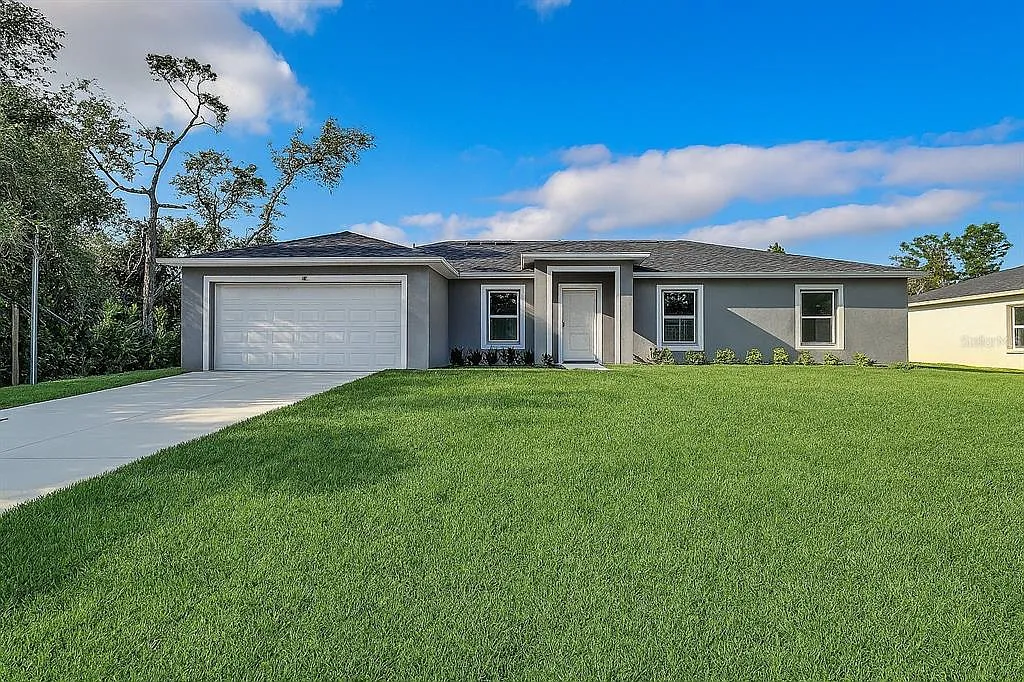
Out‑of‑State investors can compare Tennessee’s newer rental with higher NOI vs Florida’s A+ property with strong yield. Which fits YOUR investment strategy?
We have much more inventory available than what you see on our website – Let us know about your requirement.
📈 Choose Your Winner & Contact Us Today!
Speak to a Norada Investment Counselor (No Obligation):
(800) 611-3060
Mortgage rates remain high in 2026, but rental properties continue to deliver strong cash flow and appreciation. Savvy investors know that turnkey real estate is the path to passive income and long‑term wealth.
Norada Real Estate helps you secure turnkey rental properties designed for immediate cash flow and appreciation—so you can invest smartly regardless of interest rate trends.
Also Read:
- Mortgage Rates Predictions Backed by 7 Leading Experts: 2025–2026
- Mortgage Rate Predictions for the Next 3 Years: 2026, 2027, 2028
- 30-Year Fixed Mortgage Rate Forecast for the Next 5 Years
- 15-Year Fixed Mortgage Rate Predictions for Next 5 Years: 2025-2029
- Will Mortgage Rates Ever Be 3% Again in the Future?
- Mortgage Rates Predictions for Next 2 Years
- Mortgage Rate Predictions for Next 5 Years
- Mortgage Rate Predictions: Why 2% and 3% Rates are Out of Reach
- How Lower Mortgage Rates Can Save You Thousands?
- How to Get a Low Mortgage Interest Rate?
- Will Mortgage Rates Ever Be 4% Again?